 DGactual
Nobody Trusts Yelp. Nobody Can Quite Ignore It Either.
Franchise dealers have been right to distrust Yelp for two decades. What they have not reckoned with is what the platform has become in its decline, and where that leaves their rating on a Sunday morning when a customer is trying to find their lot.
Franchise auto dealers have had a complicated relationship with Yelp for two decades. They distrust it. They suspect the algorithm is rigged, the review pool is poisoned, and the whole enterprise is designed to extract advertising dollars from businesses by making them feel like hostages to their own ratings. These concerns have a real basis. The grievances are documented, and in several cases they have been tested in court. The platform is, by every measurable signal, in genuine decline. The stock is down significantly from its all-time high. Paying business locations fell 6% year over year in Q1 2026, per Yelp's Q1 2026 earnings release. Goldman Sachs has a $25 price target and Morgan Stanley rates the stock Underweight.
The dealerships are right to be skeptical. What they have not fully reckoned with is what the platform has become in its decline, and where that decline leaves their rating on a Sunday morning when a customer is trying to find their lot.
A Platform Built for the Aggrieved
Yelp was not engineered to collect representative customer opinions. It was engineered to collect motivated writers. Those are two completely different populations, and the gap between them explains almost everything that follows.
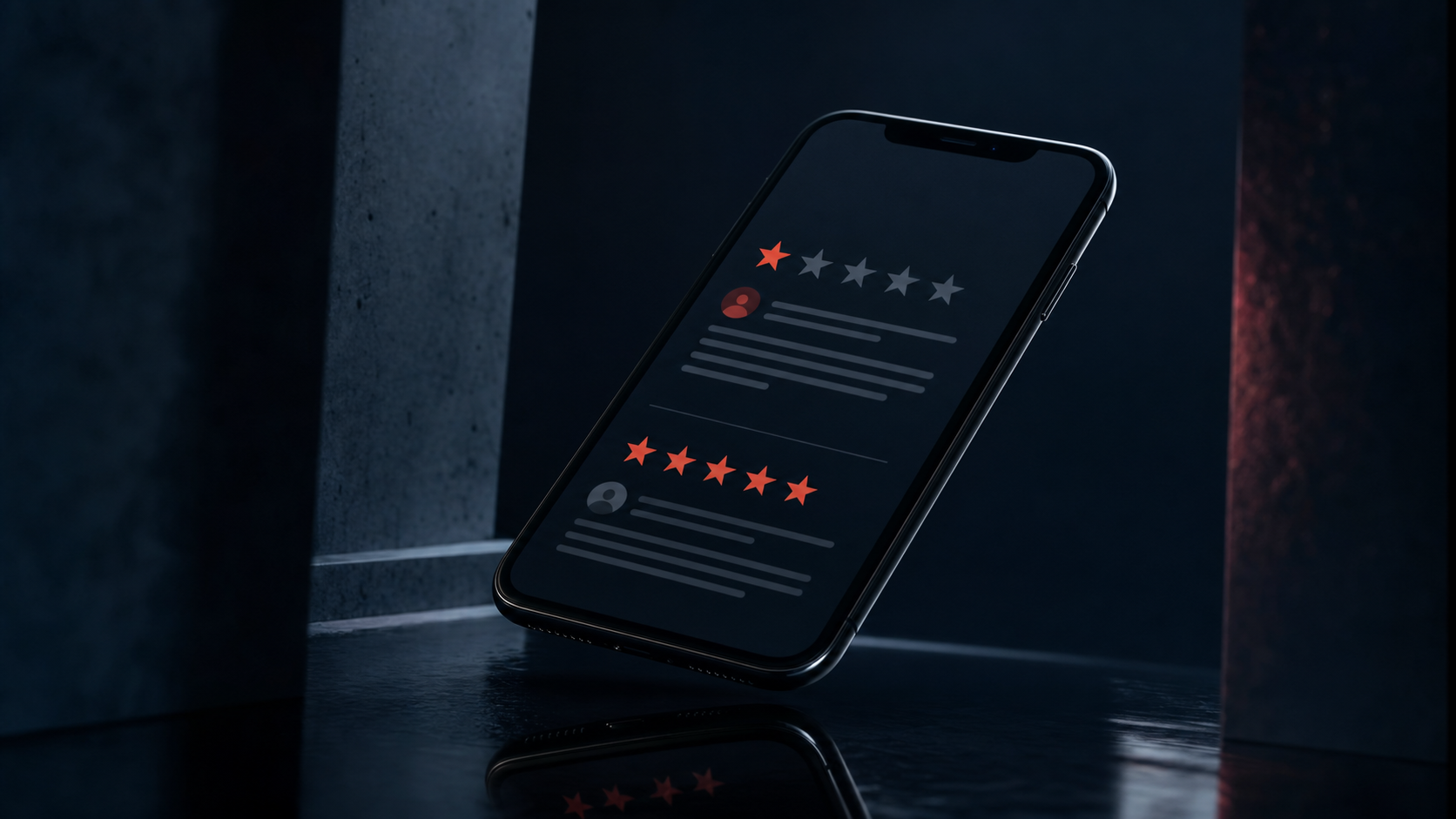
Start with the shape of the data itself. According to a WallStreetZen 2024 analysis of Yelp's own figures, 53% of Yelp reviews are five-star. Eighteen percent are one-star. Combined, 71% of all reviews live at the extreme ends of the scale. The middle three ratings (two, three, four) share the remaining 29% between them. This is not what a representative sample of customers looks like. It is what a self-selected sample of people who felt strongly enough to act looks like. The customer who had a decent experience, got what they came for, and went home did not write a review. The customer who was furious wrote one before they got to their car.
For franchise dealers specifically, a 2021 Yale Cowles Foundation study by Chakraborty et al. produced a number worth noting: 46.9% of Yelp reviews at chain-branded businesses are one-star. Not one-star heavy. Not slightly skewed negative. Nearly half of all reviews are one-star. When a customer walks into a recognized brand, they carry expectations built over years of advertising, cultural conditioning, and prior experience with the category. When the visit confirms those expectations, they go home. When it does not, the perceived gap between promise and experience is sharper than it would be at an unknown independent shop. The review gets written. The satisfied customer does not.
The pandemic shifted something structural in reviewing behavior. The 2023 National Customer Rage Survey documented that revenge reviews, meaning reviews written specifically to punish a business, tripled from 3% to 9% of all online reviews between 2020 and 2023. Angry reviewing became normalized behavior in those years. It has not receded.
A 2021 MIS Quarterly study out of Georgia Tech found that angry reviews are rated by readers as less helpful than calm, measured reviews. And yet they are more persuasive in actually changing purchase behavior. The reviews people consciously rank as lower quality are the reviews that most effectively change what people do. That is a fundamental problem baked into the review ecosystem, and it operates on every dealer's Yelp page every day.
The platform also classifies roughly 16% of its own reviews as "not recommended," flagged by its algorithm as potentially suspect. That is the platform's internal acknowledgment that a meaningful share of its own content should not be trusted. It does not remove those reviews. It hides them behind a secondary tab that most users never find. One in six reviews is questionable by the platform's own assessment, and the platform buries that acknowledgment rather than surfacing it.
A franchise dealership on Yelp is not being evaluated. It is being processed by a system that was architecturally designed to amplify the motivated, and for recognized brands operating in high-expectation categories, the motivated skew heavily toward the disappointed.
Compressed From Every Direction
Yelp's competitive position is not merely declining. It is being squeezed from multiple directions simultaneously, and the automotive category has essentially already moved on.
Google holds somewhere between 73% and 81% of all online reviews, depending on the measurement period and methodology. A Map Labs study of 100 businesses over six months found Google generating 50 times more views and actions per business profile than Yelp. Not 50% more. Fifty times.
Not 50% more. Fifty times.
The automotive-specific data is the sharpest signal. The Cox Automotive 2024 Car Buyer Journey Study did not list Yelp among the platforms car buyers use. The Widewail Q1 2025 Voice of the Customer Report tracked 1.4 million Google automotive reviews in a single quarter, growing 33% year over year. Widewail, a firm that specializes in automotive reputation management, does not track Yelp automotive reviews at all. When the firms that make their living monitoring automotive reputation stop indexing a platform, that platform has left the category conversation.
Then there is the front door that is closing fastest. The BrightLocal 2026 Local Consumer Review Survey, published February 11, 2026, found that 45% of consumers now use AI tools like ChatGPT or Gemini for local business recommendations. One year earlier, that figure was 6%. A 7.5x increase in twelve months. AI is now the third most popular source for local business recommendations in the United States. Yelp is not in the top three.
AI is now the third most popular source for local business recommendations in the United States. Yelp is not in the top three.
Losing ground to Google from above. Losing the emerging AI discovery layer from the front. Losing automotive category relevance from the side. The compression is operating on every axis simultaneously.
Twenty Years of Staying in Business
The legal history of Yelp is long and worth understanding in context. This is a company that has faced sustained legal pressure from multiple directions and has, for the most part, navigated it without losing in court. The record is complicated.
In September 2011, Yelp CEO Jeremy Stoppelman testified before the Senate Judiciary Committee, positioning Yelp as a victim of Google's manipulation of search results. Two years later, in 2013, the New York Attorney General's Operation Clean Turf found 19 companies paying more than $350,000 in fines for purchasing fake Yelp reviews. Yelp was now the platform being gamed.
In 2014, the Levitt v. Yelp ninth circuit ruling dismissed claims that Yelp manipulated reviews to coerce advertising purchases. The court's finding was narrow: the alleged conduct did not meet the legal definition of extortion under California law. The court did not find that no manipulation occurred. It found that the alleged conduct cleared the bar for "hard bargaining." That same year, the FTC opened an investigation into Yelp's practices and closed it without action. Also that year, Yelp paid a $450,000 COPPA settlement for collecting personal information from children without parental consent.
The two cases that produced monetary settlements are instructive. In 2022, an $18 million investor class action settlement was paid personally by CEO Jeremy Stoppelman, former CFO Charles Baker, and COO Joseph Nachman. The allegation was that executives misled investors about the performance of Yelp's cost-per-click advertising system while selling shares at elevated prices. In 2023, a $15 million class action settlement covered more than 400,000 business owners who alleged Yelp secretly recorded sales calls without consent. It was described as one of the five largest phone call class action settlements in California history.
In 2024, Yelp filed its own antitrust lawsuit against Google, alleging that Google illegally self-preferences its own local results to suppress Yelp. For context: Yelp's own Senate testimony established that 80% of its web traffic comes from Google. The company suing Google for suppression is the same company that has openly acknowledged it depends on Google for the vast majority of its audience.
Where Your Yelp Score Still Gets Seen
Here is the part that changes the calculation for dealers who have decided to simply ignore Yelp.
Yelp's direct traffic is declining. That is real and documented. But direct traffic to Yelp.com is not the only way a customer sees your Yelp score. The embedded channel through Apple Maps operates on a separate track, and it has not declined in the same way.
Apple Maps sources its US reviews primarily from three third-party providers: Yelp, TripAdvisor, and Foursquare. Yelp is the most common source. Apple launched its own native ratings system in August 2021, giving Maps users a way to leave reviews directly inside the app. Three years in, it has not gained significant traction with users. Yelp-sourced data still dominates what a customer sees when they tap on a business in Apple Maps. The Yelp Q1 2026 earnings call explicitly listed Apple Maps as an expanded data licensing integration partner, alongside Amazon Alexa, Microsoft Bing, Meta.ai, and Yahoo. The relationship is now commercially formal.
Apple's iPhone reached 69% US smartphone market share in Q4 2025, per StatCounter Q4 2025 data, its highest ever. Not every iPhone owner uses Apple Maps, and the actual exposed audience accounting for those who default to Google Maps or Waze is closer to half that figure. Which still produces an estimated 82 to 140 million US monthly Apple Maps users, all of them seeing Yelp as the review layer when they tap a business.
A dealer who has never spent a dollar on Yelp, has never claimed their profile, and treats the platform as a relic still has a Yelp score sitting inside Apple Maps, visible to somewhere between 82 and 140 million people who opened their navigation app this month. When one of those users taps a dealership in Apple Maps, the reviews that populate are Yelp reviews. That is not theoretical exposure. It is ambient, daily, unmanaged visibility on a platform the dealer thinks they have opted out of.
The Part Where Yelp Might Have a Point
This piece would be intellectually dishonest without this section, and intellectually dishonest articles do not get forwarded.
Independent research raises a fair point about accuracy. FTC economist Devesh Raval's 2024 research compared ratings across platforms for businesses with documented BBB complaints, a reasonable proxy for actual service failures. The findings suggest that Yelp ratings tend to land lower than Google ratings for businesses with documented service issues. Whether that reflects genuine accuracy or simply the platform's structural skew toward motivated, dissatisfied reviewers is genuinely debatable. But it is worth noting that the skew is not fabricating positive ratings for businesses that have earned negative ones.
The review content data reinforces a different and more useful point. Fifty percent of Google reviews contain fewer than 100 characters. Thirty-two percent of Google reviews contain no text at all, a star rating with nothing behind it. Yelp reviews sit in a fundamentally different information class: 28% of Yelp reviews run between 501 and 1,000 characters, and 18% run longer than 1,000. Five or six sentences of actual narrative, naming people, describing specific events, explaining what went wrong and what the customer expected and what they will do differently next time.
That longer text may contain operationally useful information. Not because Yelp's star ratings are reliable, but because the words behind the stars are worth reading. A one-star Yelp review that runs 800 characters naming a specific service advisor, describing a specific miscommunication, and explaining what the customer wanted instead is operational feedback. It may be written in anger. That does not make the signal inside it less real.
So here is the actual tension: the Yelp score for a franchise dealer is structurally depressed, almost certainly lower than the true center of customer experience, for all the reasons laid out above. And the individual reviews behind that score are probably more operationally useful than anything sitting in the Google queue. The number is probably wrong. The words behind it deserve more attention than they usually receive.
What to Do With All of This
A few things follow from all of this.
A Yelp score is not an absolute quality measurement. A 3.2 on Yelp alongside a 4.6 on Google is not a service crisis. It is a measurement problem. Two instruments measuring two different populations, using two different filters on what gets submitted and what gets surfaced, producing two different readings of the same operation. A physician who gets different numbers from two different instruments does not panic. They understand what each instrument measures.
Responding to Yelp reviews is worth doing, not because Yelp's platform deserves the investment as a standalone business proposition, but because the response is visible to the 82 to 140 million Apple Maps users who accessed their navigation app this month and never visited Yelp.com at all. Writing a thoughtful response to a one-star Yelp review is not an act of capitulation to a problematic platform. It is a communication to a customer base that is orders of magnitude larger than the Yelp audience.
The text of Yelp reviews is operational data. The dealer who reads a one-star Yelp review as diagnostic intelligence rather than as a personal attack is in a better position than the dealer who dismisses it as the rant of a bad-faith actor. Most of the time, it is both. That does not make the operational signal inside it less real.
What has Yelp become? A platform in a documented, verifiable slide, whose paying advertisers are declining, whose web traffic is eroding, whose restaurant and retail segment fell 12% in its most recent quarter, and whose stock is trading at a fraction of what it was worth during the Obama administration, per Yelp investor relations. And simultaneously: a platform whose review content is more diagnostically substantive than its dominant competitor's, whose scores are embedded inside the mapping application on roughly half of all US smartphones, and whose data licensing agreements are expanding even as its direct audience contracts. Decline and irrelevance are not the same thing.
Decline and irrelevance are not the same thing.