 DGactual
Three Auto Groups Became Banks. The Fed Just Told Us How That Bet Is Going.
Lithia, AutoNation, and Carvana each run their own lending arm. Same market, same Fed data, three completely different bets. How big each one really is, and who has it right.

Here is a strange pair of facts. American lenders wrote $211 billion in auto loans last quarter, the largest quarterly volume in the history of the New York Fed's data. (A nominal record, the Fed is careful to note: adjust for six years of price inflation and it roughly matches the 2021 peaks. Still, a record is a record.) And they did it while more auto loans are going seriously bad than at any point since the Fed started keeping score.
Banks looked at that picture and did not loosen. The Fed's July survey of loan officers found standards basically unchanged and already sitting toward the tighter end of their historical range. So the interesting question is not whether credit reopened. It did. The question is who stepped up to write the business banks would not touch, and three of the public dealer groups have an answer sitting right on their balance sheets: they became the bank themselves.
Lithia, AutoNation, and Carvana each run their own lending operation. Same market, same quarter, same Fed data on the wall. Three completely different bets. Let's look at how big each bet actually is, and whether it's a good one.
First, the backdrop they're all lending into
In the first quarter of this year, auto lending was actually shrinking. The Fed's consumer credit data showed motor vehicle loan flow at negative $9.6 billion, meaning payoffs and charge-offs outran every new loan written in America. One quarter later that number swung to positive $47 billion, and the average 60-month new car rate dropped from 7.53% to 7.14%. Credit did not gradually thaw. It snapped open.
It snapped open into ugly conditions. Total auto debt hit $1.713 trillion, the highest ever. The flow of loans turning seriously delinquent ticked up to 3.00%. And back in Q1, the share of all auto balances sitting 90 or more days past due reached 5.6%, breaking a record that had stood since 2010. Every lender in the country can see this data. The banks responded by keeping the filter tight and letting volume through selectively.
Which means the loans that fall outside that filter, the negative equity rolls, the stretched payment-to-income deals, the buyer with a 640 and a trade worth less than its payoff, all need to find a home somewhere else. Keep that in mind as you read what follows.
Lithia: the quiet flex
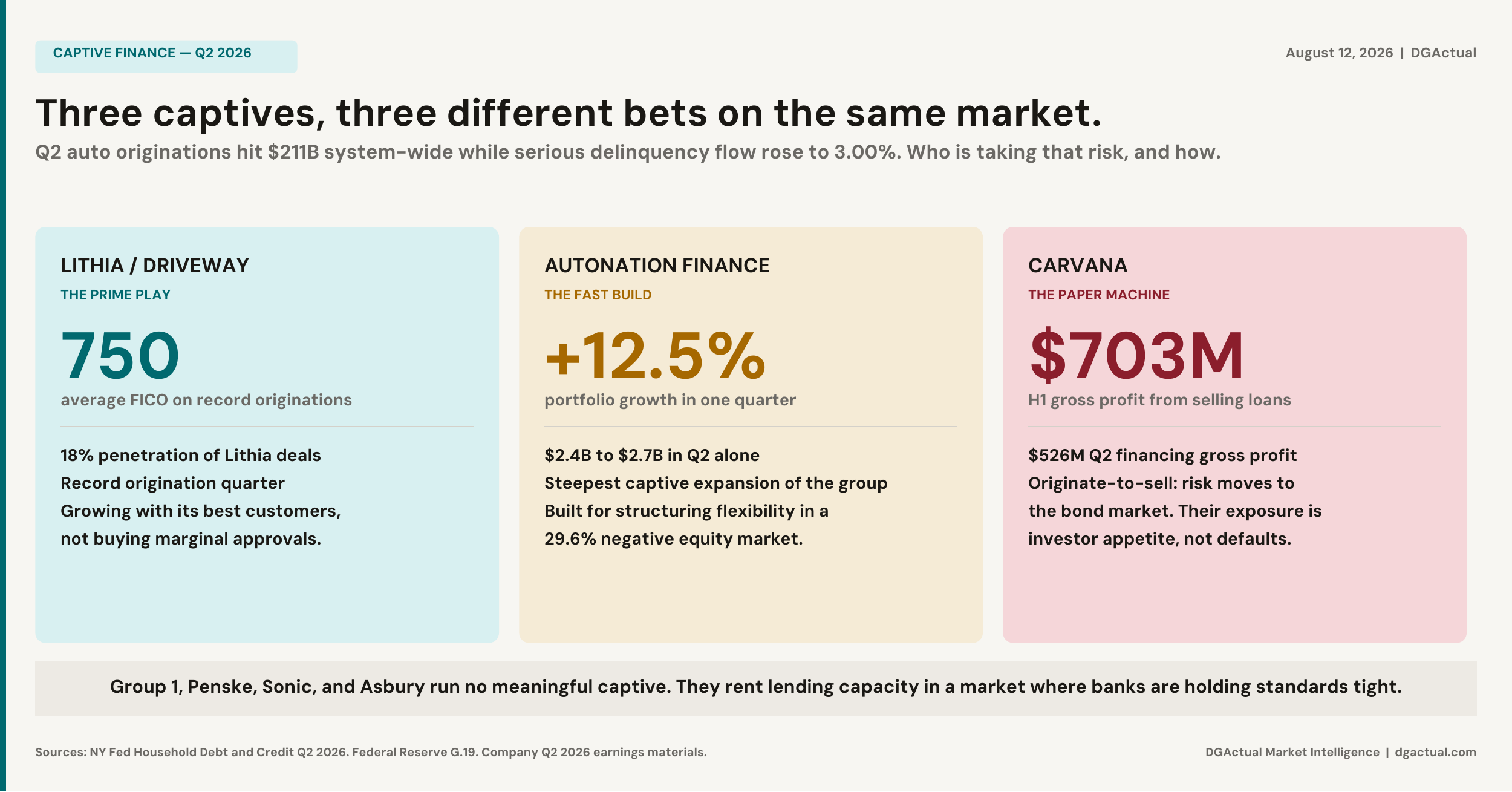
Driveway Finance, Lithia's in-house lender, just posted a record origination quarter. Two numbers tell you everything about how they're running it: 18% of Lithia's deals now finance through Driveway, and the average FICO on what they booked is 750.
Think about what a 750 average means. That customer gets approved anywhere. Any bank, any credit union, any captive in the country wants that loan. Lithia is not using its lender to rescue deals. It's using its lender to keep the best paper in the building instead of handing it to a third party, and it's doing that on nearly one deal in five.
As a share of the total business, Driveway is still a side dish. Lithia is a company that did about $1.5 billion in gross profit last quarter, and the lending arm's contribution is a fraction of that. But that's the point of the strategy: it's not supposed to carry the company, it's supposed to compound. Every point of penetration converts finance income that used to leak to a bank into income that stays home, on paper so clean it barely adds risk.
The evaluation: this is the strategy you run when you plan to still be doing it in ten years. Low risk, boring, and quietly brilliant in a rising delinquency tape. If the credit cycle gets worse, a 750-FICO book is exactly where you want to be standing. The only knock is ambition. Lithia is leaving the harder, higher-margin lending to others, on purpose.
AutoNation: the sprint
AutoNation Finance grew its loan portfolio from $2.4 billion to $2.7 billion in a single quarter. That's 12.5% growth in ninety days, the fastest captive expansion among the publics.
Scale check: $2.7 billion sounds enormous until you set it against a company that did $6.9 billion in revenue last quarter alone. The portfolio is a balance sheet line, not yet a profit engine, and its earnings contribution today is modest. What AutoNation is really buying with that growth is deal flow. Almost a third of trade-ins now carry negative equity, averaging $6,884 underwater. Third-party lenders increasingly pass on those structures. A captive can say yes, keep the sale alive, and book the finance income too.
The evaluation: the logic is completely rational and the timing is the risk. A loan book built at sprint pace, in the exact quarter the system-wide delinquency flow is rising, reveals its true quality later. Nothing in the Q2 numbers says AutoNation's paper is bad. What the numbers say is that they're growing fastest precisely when the current is strongest. If their underwriting held, this looks like the smartest land-grab of the cycle by 2027. If it didn't, 2027 is when everyone finds out. They're also the group with the least room for error given what else is on the desk: a public $2,000 used vehicle GPU target they're still $418 short of.
Carvana: the toll booth
Carvana's lending operation produced $526 million in gross profit last quarter. Selling the actual cars produced $593 million. Read that again: for every dollar the car business earned, the loan business earned almost ninety cents. Across the first half of the year, one line item, gain on sale of loans, delivered $703 million.
The mechanism matters more than the number. Carvana writes the loan at checkout, packages it with thousands of others, and sells the paper to investors. The profit books immediately. The default risk mostly leaves with the paper. They're not really a lender in the way Driveway or AutoNation Finance is a lender. They're a toll booth between car buyers and the bond market, collecting a fee on every loan that passes through.
The evaluation: as a machine, it's the most profitable of the three by a mile, and it's the reason reading Carvana's margins like a car dealer's margins gets you the wrong answer about the company. But the machine has one dependency the other two don't: the bond market has to keep showing up. Carvana's risk isn't their borrower missing a payment. It's investors reading the same NY Fed delinquency data we just walked through and deciding auto paper deserves a lower price. If that happens, the biggest profit engine at Carvana compresses without a single customer defaulting. The other two captives own their risk. Carvana rents theirs out, and rented risk can always come home.
So who's right?
Honestly, they might all be, because they're not actually playing the same game. Lithia is protecting margin it already earned. AutoNation is buying market share in deals other lenders won't write. Carvana is running a fee business that happens to involve cars.
But if you force a ranking against the credit data as it stands: Lithia's position is the strongest because it wins in either direction. Credit improves, they grew a profitable book. Credit worsens, they're holding the cleanest paper of the three. Carvana's machine is the most profitable but carries the most leverage to forces outside its control. AutoNation took the boldest swing, and bold swings in lending get graded eighteen months later, not now.
The number that settles all of it is the delinquency curve, and the next reading lands August 17 when the Fed posts second quarter bank data. We track it every week in the Monday brief, free at dgactual.com.
Sources: Federal Reserve Bank of New York, Household Debt and Credit Report Q2 2026 (originations, balances, delinquency transitions; Q1 2026 for the 90-day record). Federal Reserve G.19 Consumer Credit, August 2026 (loan flow, 60-month rate). Federal Reserve Senior Loan Officer Opinion Survey, July 2026. Company Q2 2026 earnings materials: Lithia Motors, AutoNation, Carvana. Negative equity: Edmunds Q2 2026. DGActual Market Intelligence.