 DGactual
The Used Market Is Softening Before the Headlines Admit It | Week of September 28, 2026
DARPI Near-New is 95.32 after 12 straight down weeks. A 16.1 million-unit new-vehicle pace, rising used-loan rates, a $710M subprime lending settlement, and a deepening U.S.-Canada tariff fight explain why volume can hold up while the used market gets softer underneath.

The used-car market is sending two signals that look contradictory until you put the financing bill between them. Used auto loan rates just moved to 6.738 percent, while September new-vehicle sales are still tracking a 16.1 million-unit SAAR. Underneath that headline pace, the average new-car payment is $821, 13.9 percent of loans now run 84 months or longer, and retail asking prices in our own index just fell for the 12th straight week. Add a 7.3 percent rise in new-car incentive spending, a used market being pitched as the affordability release valve, and a projected flow of more than 300,000 EV lease returns this year, more than double last year's pace, per CDK Global data, and the thread is clear: volume can hold up while the price discovery underneath it gets softer.
Overview
Here is the whole board before we open the hood. Our own DGActual model forecasts Q3 SAAR at 16.49 million units. The raw federal data we feed into that model reads 16.974 million right now, higher because it counts medium and heavy trucks alongside passenger vehicles, a definitional gap, not a forecast miss, and we unpack both numbers in the Economy and Credit section below. DARPI Near-New is 95.32, down 0.72 points week over week and 4.68 points below the June 8 baseline after 12 straight down weeks. The retail-wholesale spread is -2.43, wider than -1.71 the prior week. The FSBO screen finds three verified OPPORTUNITY rows, one MILEAGE MIX row, one NEAR PARITY row, and three ANCHORED rows in the mileage-matched set. The safety desk has three campaigns, led by 508,354 affected vehicles in the first recall.
Economy & Credit
Start with SAAR, because the acronym can make a normal store conversation sound like a macro seminar. SAAR means seasonally adjusted annual rate, basically what this month's sales pace would add up to if you ran it for a full year. Our own model puts Q3 at 16.49 million units, J.D. Power and GlobalData put September's external read at 16.1 million, and the pace is holding even though it should not feel like it, because dealers are propping the whole thing up with money. Average payment: $821 a month, a September record. Almost 14 percent of loans now stretch to 84 months or longer. Negative equity sits at 29.4 percent of trade-ins. Incentive spending jumped 7.3 percent to $3,574 a car. Nobody's buying confidently here. Everybody's being financed into staying in the game.
Now add the rate hike on top of a bill that was already stretched thin. The Fed moved on September 16, a quarter point to 3.75-4.00 percent, and MonitorBankRates clocked used auto loan rates at 6.738 percent and new-car rates at 5.931 percent right after, used rates up 0.235 points from late August. Nobody is defaulting over a quarter point. But every shopper who was already close to the edge on payment just got pushed a little closer, and that is exactly the kind of pressure that makes buyers slow down, cross-shop harder, and demand the lot actually prove a car is worth the number on the sticker.
Here is the part that should worry you more than the rate hike: consumers are getting nervous while the job market says they have no reason to be. University of Michigan's final September sentiment reading dropped to 48.1, down from 51.7 in August, a four-month low, with one-year inflation expectations jumping to 4.6 percent from 4.0. Meanwhile jobless claims fell to 197,000 for the week ended September 19, near a 57-year low. Confident labor market, spooked household outlook on prices, both true at once. That gap is exactly what turns payment math into the deciding factor on whether someone buys new, buys used, or just waits it out.
One more credit-market story belongs in this section, because it is a preview of where regulators are pointing next. Credit Acceptance, one of the country's largest subprime auto lenders, agreed to a $710 million settlement with 40 states and Washington, D.C. on September 17, resolving charges that it steered low-income, low-credit borrowers into loans it knew they could not afford, and helped dealers push add-ons like service contracts and insurance those buyers did not need. The deal forgives $634 million in debt for more than 55,000 borrowers, adds $60 million in restitution and a $15.5 million civil penalty, and covers loans written between November 2015 and November 2025. Watch the F&I desk here: this is the exact playbook regulators are now willing to unwind after the fact.
DARPI: Twelve Straight Weeks Down
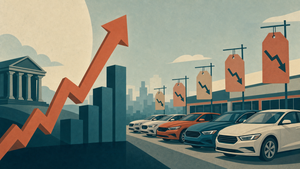
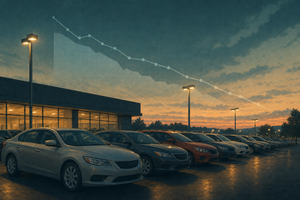
Now the store-level check. DARPI tracks used retail asking prices from dealer listings across 11 vehicle segments, indexed to 100 at June 8. Near-New is 95.32, down 0.72 points week over week and 4.68 points versus the June 8 baseline, the 12th consecutive weekly decline. The Value cohort is 96.0, down 0.49 points. The retail-wholesale spread is -2.43, compared with -1.71 last week, meaning retail asking prices are moving below the wholesale benchmark rather than simply drifting in parallel with it. The move is not uniform: Luxury SUV fell 1.16 points, while Compact Car and Fullsize Pickup each fell 0.86 points. That is a market giving buyers more room, but giving it unevenly by segment.
FSBO Acquisition Desk
That unevenness is why the FSBO desk earns a place in the brief. FSBO means for sale by owner, private sellers, not dealerships. We match both sides on mileage, the same 20,000 to 60,000 mile band, so a discount is a real discount and not just one side having beater mileage. DOM means days on market, and we track both clocks: lifetime DOM and current-listing DOM, the active run since the ad was last refreshed. Every model below is the 2022 to 2025 cohort on both sides. Four labels do the talking, here is the plain-English version:
- OPPORTUNITY: a real, mileage-matched discount, at least 10 comparable FSBO listings and a spread over $500 below dealer retail. Worth a driveway look.
- ANCHORED: the private seller is at or above dealer retail even after matching mileage. No discount to chase.
- MILEAGE MIX: the raw, unmatched discount looks huge on paper, then vanishes once you control for mileage. The private sellers just had higher-mileage cars, they were not pricing cheaper.
- NEAR PARITY: the honest fourth answer. The spread is small either direction and does not clear the bar for a real signal, so we say that instead of forcing it into a box.
Nissan Rogue 2022-2025: matched n 16, band spread -723, dealer current-listing DOM 38 versus FSBO current-listing DOM 27, verified_signal OPPORTUNITY.
Toyota Camry 2022-2025: matched n 24, band spread -24, dealer current-listing DOM 30 versus FSBO current-listing DOM 23, verified_signal MILEAGE MIX.
Honda CR-V 2022-2025: matched n 12, band spread -2147, dealer current-listing DOM 29 versus FSBO current-listing DOM 26, verified_signal OPPORTUNITY.
Tesla Model Y 2022-2025: matched n 148, band spread -1572, dealer current-listing DOM 20 versus FSBO current-listing DOM 121, verified_signal OPPORTUNITY.
Honda Accord 2022-2025: matched n 15, band spread -390, dealer current-listing DOM 32 versus FSBO current-listing DOM 28, verified_signal NEAR PARITY.
Jeep Grand Cherokee 2022-2025: matched n 21, band spread 1466, dealer current-listing DOM 43 versus FSBO current-listing DOM 57, verified_signal ANCHORED.
Toyota RAV4 2022-2025: matched n 17, band spread 3858, dealer current-listing DOM 30 versus FSBO current-listing DOM 18, verified_signal ANCHORED.
Ford F-150 2022-2025: matched n 109, band spread 4994, dealer current-listing DOM 51 versus FSBO current-listing DOM 41, verified_signal ANCHORED.
Trade & Tariffs
The U.S.-Canada trade fight is not staying theoretical. The U.S. Trade Representative said on September 25 there is "no urgency" on a Canada deal, new U.S. import bans on Canadian goods take effect the following week, and Washington is threatening to double tariffs on Canadian autos, parts, and steel to 50 percent starting January 1, 2027. The early damage already shows: the U.S.-built share of new-vehicle sales in Canada fell to 28.4 percent in the first half of 2026, down from 35.4 percent a year earlier and roughly 40 percent through most of 2021 to 2025, per J.D. Power Canada, with Japan and South Korea picking up the share American brands are losing. Michigan carries the biggest exposure on this side of the border, supplying roughly 22 percent of U.S. intermediate automotive imports from Canada, and the cross-border list is not abstract: Chevrolet Silverado from Oshawa, Chrysler Pacifica from Windsor, Toyota RAV4, Honda Civic and CR-V, and Ford Super Duty trucks planned for Oakville all depend on parts and assembly moving across the Detroit River. One economist's projection for Ontario under a sustained tariff scenario: about 119,000 fewer jobs and manufacturing output 8 percent below where it would otherwise be. None of that is locked in, automakers can absorb cost, re-source parts, or qualify for exemptions before the January deadline hits, but the clock is real and it is not on either side's side.
Trade & OEM Read
The broader industry read points in the same direction as the index, but with more activity than panic. CBT News, citing the CarGurus Intelligence Report, put the average used-vehicle price at $30,200 in August, the fourth straight month at that level, with used-vehicle demand up 2.3 percent year over year even as new-vehicle sales fell nearly 4 percent. Days' supply, the pace-adjusted read on how long current inventory would last at the current sales rate, ran about 52 days for vehicles under $30,000 and 91 days for vehicles above $80,000, a real gap in how fast the affordable end of the lot turns versus the top end. CDK Global data, reported by CBT News, projects more than 300,000 EV lease returns in 2026, more than double the roughly 123,000 in 2025, mostly from 2022-23 leases, adding two and three-year-old EVs to used inventory. That is a merchandising opportunity, not a reason to buy every discounted unit. The clean buy is the one whose value story survives a payment conversation and a second look at days on market.
Safety Desk
The safety desk is unusually practical this week. Campaign 26V511000 covers 2025-2026 Toyota Camry Hybrid with 508,354 affected vehicles. Campaign 26V587000 covers 2025 Volkswagen Tiguan with 49,958 affected vehicles. Campaign 26V539 covers 2024-2026 Buick Encore GX; 2024-2025 Buick Envista; 2024-2026 Chevrolet Trailblazer; 2025 Chevrolet Trax with 306,511 affected vehicles. The exact defects and dealer angles are different, but the operating play is the same: identify affected owners, make the update or camera repair easy, and use the visit to complete a multipoint safety inspection.
Notes
One transparent data note: the Fullsize Car segment's vs-baseline figure stays out of this brief. The June 8 baseline pull returned zero listings for that segment, so a comparison would measure a broken starting point rather than a real market move. It comes back when the segment is re-anchored.