 DGactual
DGActual Market Brief — Week of August 10, 2026
A default record that stood since 2010 just broke. July sales slowed while payments set a July record. Honda doubled profit with two plants dark. And used retail prices logged a fourth straight week of contraction.

JUMP TO SECTION
The Fed held rates with three dissenters pushing for a hike. July sales slowed toward our model's number while the average new car payment set a July record at $808. Auto loan delinquency broke a record that had stood since 2010. Honda more than doubled its operating profit while two of its plants sit dark until August 19. And used retail prices logged a fourth straight week of contraction, falling four times further than wholesale since June. Here is the week, in order of what it means for your store.
Overview: the squeeze is now visible on both ends
Two stories dominated this week, and they are the same story from opposite ends. On the demand side, the market kept drifting toward our number: the DGActual model has held Q3 at a 15.8 million SAAR all summer, and July's industry rate slipped from 16.5 to 16.3 million on its way there, even as the average payment hit $808, the highest for any July on record. On the credit side, the share of auto loan balances 90 or more days past due reached 5.6%, passing a record that had stood since the fourth quarter of 2010.
Sales are slowing while payments and defaults sit at records. That combination is the defining condition of this market right now. It shapes everything else in this brief: what the Fed sees, what lenders are doing, what your appraisal desk should assume, and where the acquisition opportunities are.
Auto credit: the record that took fifteen years to break
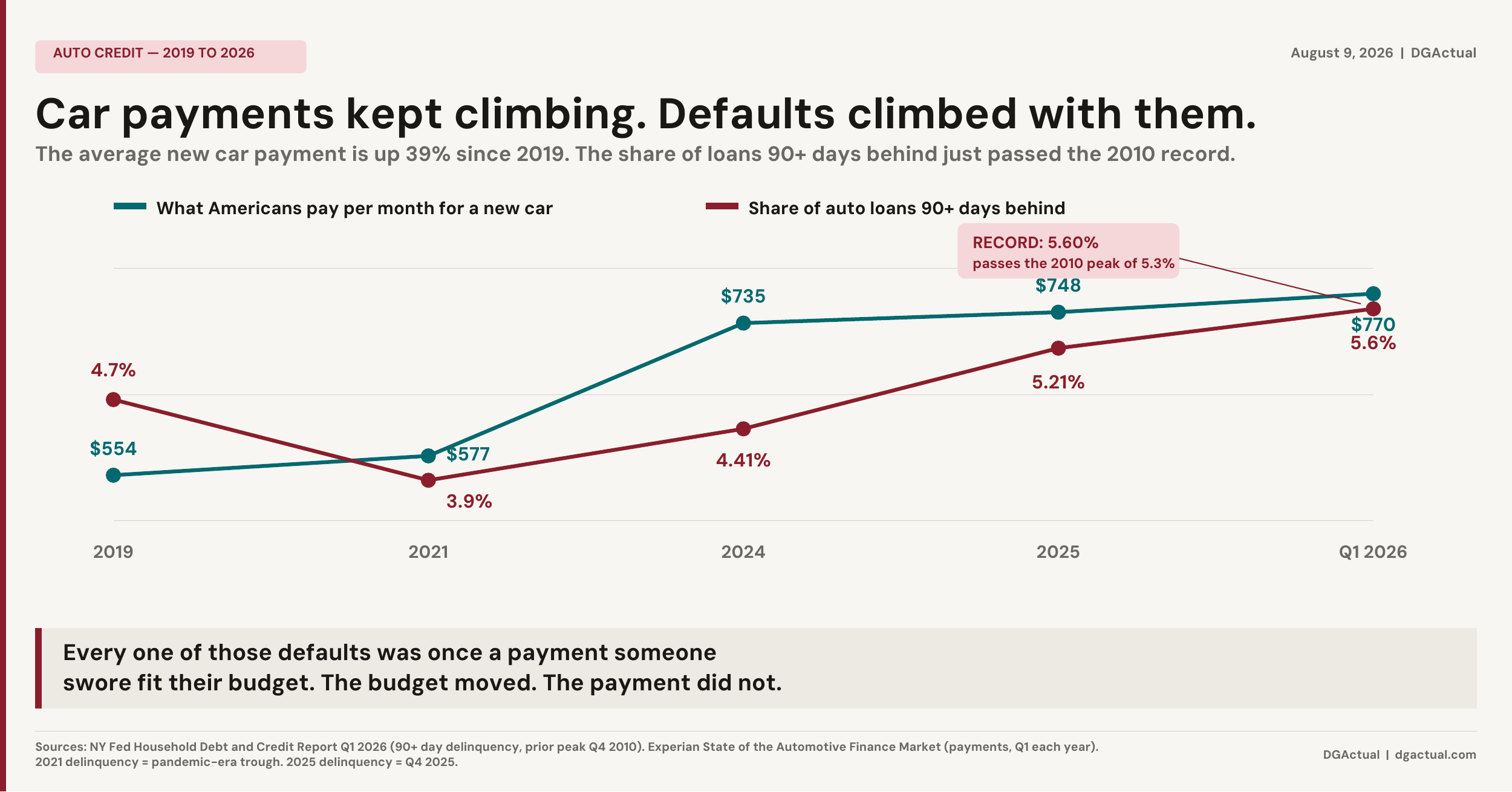
5.6% of all outstanding auto loan balances were at least 90 days past due in Q1, per the New York Fed. The old record was 5.3%, set in late 2010 when unemployment was near 10%. We just passed it with unemployment at a fraction of that. In 2010, people defaulted because they lost their jobs. In 2026, people are defaulting while employed. The payment itself became the problem.
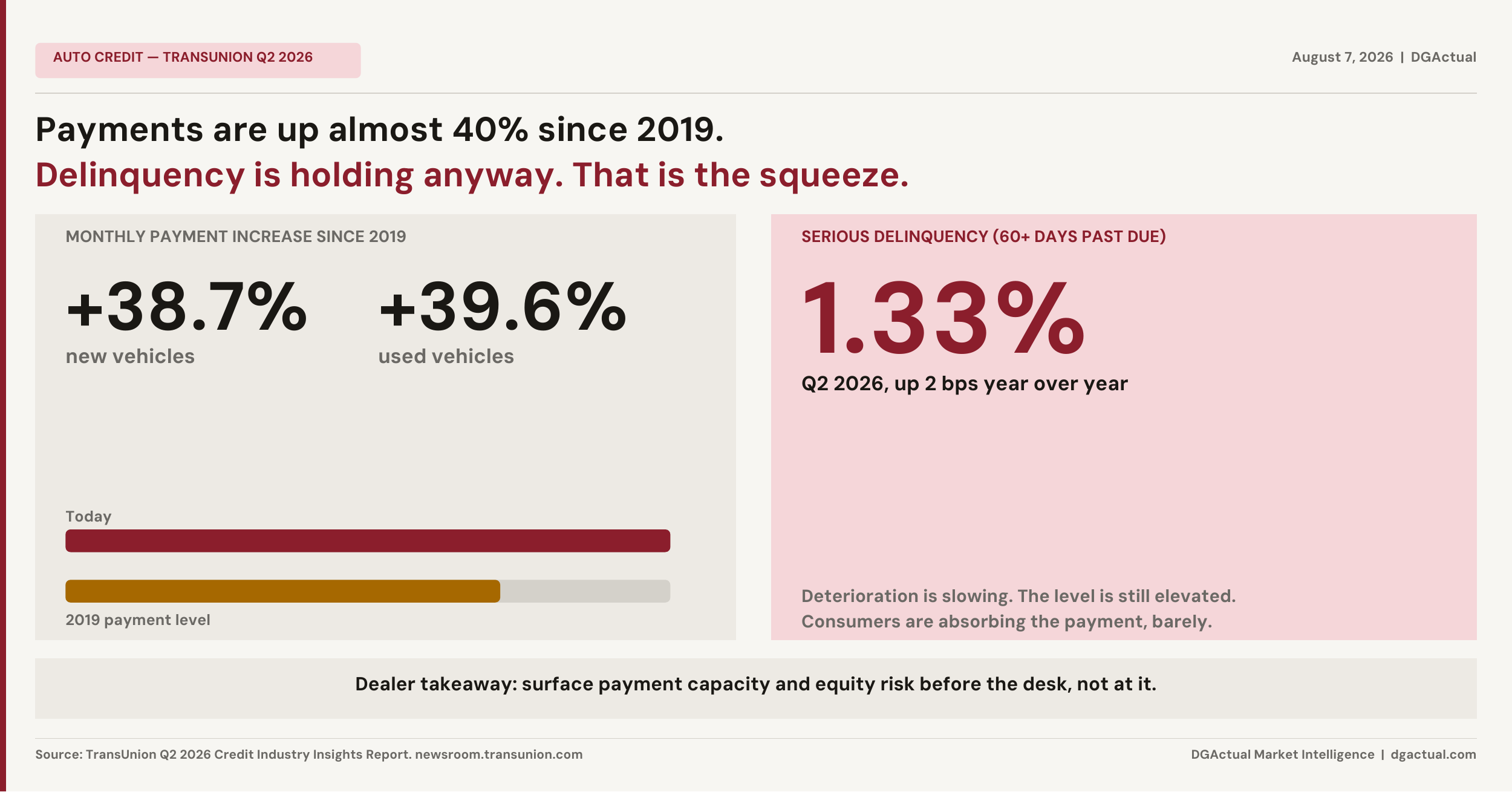
TransUnion's Q2 report added the texture. Monthly payments are up 38.7% on new vehicles and 39.6% on used since 2019. Serious account-level delinquency sits at 1.33%, up 2 basis points in a year. Deterioration is slowing, but the level remains elevated, and the Fed's own July report noted delinquency rising fastest among borrowers in low and moderate income neighborhoods. The stress is concentrating where payment capacity is thinnest.
The lending response is already visible. The Fed's July loan officer survey found a moderate net share of banks reporting weaker demand for auto loans in Q2, with standards unchanged but already sitting toward the tighter end of their historical range. Lenders are not loosening into this. Which means the deals that used to get bought at the margin are quietly not getting bought anymore.
At the desk, this all points one direction: payment capacity, equity position, and rate exposure need to be surfaced at the start of the deal, not discovered in the finance office. The stores structuring around that reality are writing loans that survive. The others are originating next year's defaults.
Sales and demand: July was soft, and the model says softer is coming
Start with our number. The DGActual model has the third quarter at a 15.81 million SAAR. It said 15.76 two weeks ago and 15.81 after Friday's refresh. It has not moved in any meaningful way all summer.
The industry numbers are drifting toward it. The light vehicle rate slipped from 16.5 million in June to 16.3 million in July, down 1.4% from a year ago, per NADA. FRED's total vehicle series, which adds medium and heavy trucks and therefore always runs higher, slipped from 17.0 to 16.8 over the same month. Every published estimate moved down. Ours held still.
SAAR, for the newer readers: the seasonally adjusted annual rate. Take a month's actual sales, adjust for the season, and it tells you what the full year would look like if every month sold like that one.
July's soft tape came with a record attached: the average new vehicle payment hit $808, the highest for any July on record, with average incentive spend at $3,451 and an average finance rate of 6.54%. Buyers are still showing up. They are paying more than any July buyer before them to do it.
Why is our model below everyone? Pull-forward. The additional 50% duty on certain Canadian-origin products lands August 19, nine days from now, and buyers with Canadian-sourced orders have had every reason to close early. The model treats that demand as borrowed from the fall, not created. If it is right, those sales get handed back in the second half of the quarter, and the July strength was the loan, not the trend.
Why a survey of how people feel is inside our sales forecast
One of the inputs in our model is the University of Michigan consumer sentiment survey. Every month, Michigan asks ordinary households how they feel about their finances and the economy. That might sound soft next to hard numbers like rates and delinquency, but it has earned its seat, and here is why.
A car is the biggest purchase most households can delay. When people get nervous about money, they do not stop buying groceries or paying rent. They keep the car another year. That decision shows up in a sentiment survey a quarter or two before it shows up on a sales report, because people feel nervous before they act nervous. Sentiment collapsed ahead of the sales declines in 2008 and again in 2022. It is one of the few forward-looking instruments we have, and right now it reads 47.3. Readings below 50 have historically been the range where households start deferring exactly this purchase.
One honest wrinkle: for the past two years, Americans have been telling Michigan they feel terrible and then buying cars anyway. The link weakened, and two weeks ago we cut sentiment's weight in the model by 15% to respect what the data was saying. We keep it in the model because fifty years of history says the mood eventually wins. We trimmed it because lately the wallet has been ignoring the mood. That tension, between what buyers say and what they do, is exactly the thing the next two quarters will settle.
OEM and production: four Japanese earnings, four different directions
All four major Japanese OEMs reported the same quarter this week, into the same tariff environment, and landed in four different places. Honda more than doubled operating profit, up 117.4% to 530.7 billion yen, and raised full year guidance to 650 billion. Mitsubishi grew profit 78.8% despite selling 8% fewer units. Nissan returned to quarterly operating profit for the first time in two years, then trimmed its full year sales forecast in the same breath. And Toyota, the giant, saw operating income fall 8.8% on softer vehicle sales.
Same quarter, same headwinds, four outcomes. The difference is mix, pricing discipline, and how much tariff cost each one absorbed versus passed through. If you hold franchises from more than one of these brands, this is the quarter where the OEM behind the sign started mattering again: allocation behavior, incentive support, and floor pricing all flow from these numbers.
Honda's win comes with an asterisk on the supply side. Two of its Japanese plants sit dark through August 19 after earthquake damage at a Kumamoto supplier, with roughly 20,000 vehicles of industry impact. Toyota, Nissan, and Daihatsu ran their own quake-related suspensions earlier in the week. And on the other side of the planet, Dacia and Ford halted Romanian production through August 19 as well, for an entirely unrelated reason: a national power crisis. Two continents, two different disasters, one restart date. If your allocation includes Japan-built or Romania-built units, the third week of August is when you find out how real the catch-up plan is.
One more production story worth a paragraph: Rivian grew Q2 revenue 27% to $1.66 billion and raised its delivery outlook for the year. The EV startup class of 2021 has mostly gone quiet. Rivian posting growth and raising guidance in this rate environment is the exception, and it says the demand problem in EV is not universal. It is concentrated in the brands that gave buyers no reason to choose them.
One tier down from the OEMs, supplier economics stay tight. Cooper Standard posted a smaller loss than expected on 2.2% revenue growth, but gross margin fell 160 basis points, and the company absorbed 8 million dollars in tariff and duty costs plus another 8 million in inflation in a single quarter. Suppliers are eating cost increases they cannot fully pass through, and that pressure eventually finds its way into parts pricing.
On the policy watch list: early reporting suggests USMCA 2.0 negotiations may include a 50% U.S. content requirement. That is a proposal, not a rule, and proposals die all the time. But if it survives, it reshapes North American sourcing more than any tariff to date. We are watching it so you can ignore it until it matters.
Recall desk: 1.5 million vehicles in a week
The week's recall log, in order of scale. Ram 1500 pickups from 2019 through 2026: 1,271,294 vehicles for a seat belt anchor issue. Ford Mustang Mach-E from 2023 through 2025: 86,543 vehicles under a do-not-drive advisory. Ford Explorer and Lincoln Aviator from 2026 and 2027: 79,579 vehicles for an unintended driver seat recline risk. Freightliner Business Class M2: 23,276 commercial units. Dodge Hornet and Alfa Romeo Tonale: 1,458 vehicles carrying both do-not-drive and park-outside guidance for a rear seat belt restraint issue, with owner notices scheduled for September 24.
The service lane read: recall completion work is booked revenue walking through your door, and the Ram campaign alone is one of the largest of the year. If you hold a CDJR service operation, the parts pipeline and scheduling capacity conversation should be happening now, before notices land in mailboxes.
DARPI: four straight weeks of contraction, and the spread keeps widening
DARPI is the DGActual Automotive Retail Price Index. It tracks used retail asking prices across 11 vehicle segments every week, indexed to a baseline of 100 set on June 8. We rebase the Manheim wholesale benchmark to the same 100 on the same date, so the two lines are directly comparable: same starting point, same scale, one retail, one wholesale.
Here is where both lines sit nine weeks later. Wholesale: 99.31, down 0.7 points from baseline. Retail: 97.21, down 2.8. Retail has fallen four times further than wholesale since June, and it dropped another 0.25 this week, the fourth consecutive week of contraction, meaning prices and listing volume moving down together.
The gap between the two lines is the spread: negative 2.10 points, the widest we have measured. When retail asking prices sink this far below a holding wholesale line, the appraisal desk math quietly breaks. The trade you price off three-week-old comps was bought above today's retail, and the retail line is still moving away from you. Wholesale is not going to bail that unit out. It is not falling, but it is not rising either.
The biggest segment move was Fullsize Car, down 1.28 points to a $29,687 median at 127 days on market. Full pickups are sitting 119 days. Minivans remain the fastest lane at 63 days. EV softened half a point, and the split inside that segment is still the real story: Tesla turns near 37 days while everything else sits past 75. Price the two like different markets, because they are.
Acquisition desk: private sellers this week
Live private-party listing data against dealer retail, pulled this morning. Four models are in opportunity territory.
Honda Accord remains the strongest buy signal: private sellers asking $21,900 against $24,998 dealer retail, a $3,098 spread. Toyota Camry is close behind at $2,710, and Camry private listings are sitting 115 days against 69 at dealers. That seller has been waiting a month and a half longer than the market and knows it. Toyota RAV4 offers a cleaner, higher-volume play at a $1,608 spread with nearly identical days on market. Tesla Model Y private sellers are asking just $720 under dealer retail but sitting 131 days against 37. That gap is motivation you can work with.
On the other side, Ford F-150 private sellers are anchored $2,173 above dealer retail, and Jeep Grand Cherokee sellers are $1,446 above at 211 days on market. Patience there. The truck seller holding out above retail in a market where dealer F-150s are already sitting 123 days will come back to earth eventually, and the store that stayed in touch gets the call.
Full segment data, model level breakdowns, and the weekly index at data.dgactual.com. Dealer reputation data across 17,814 stores at reviews.dgactual.com.
Sources: Federal Reserve (FOMC statement July 29, Monetary Policy Report, Senior Loan Officer Opinion Survey), New York Fed Household Debt and Credit Report Q1 2026, TransUnion Q2 2026 Credit Industry Insights Report, Experian State of the Automotive Finance Market, NADA Market Beat July 2026, FRED total vehicle sales, Honda investor filings, The Japan Times, CBT News, NHTSA recall filings, Cooper Standard investor materials, MarketCheck API, DGActual Retail Price Index. DGActual Market Intelligence. Week of August 10, 2026.