 DGactual
29 Million. One Pipeline. Almost Nobody Is Running It.

5 min read · Signal Intel · May 2026
29 million open campaigns, a new federal advisory category, and the most reliable service traffic in a generation. The question is whether your team is treating it like the asset it is. The answer could make a big difference in how you remember 2026.
The Number That Should Stop You
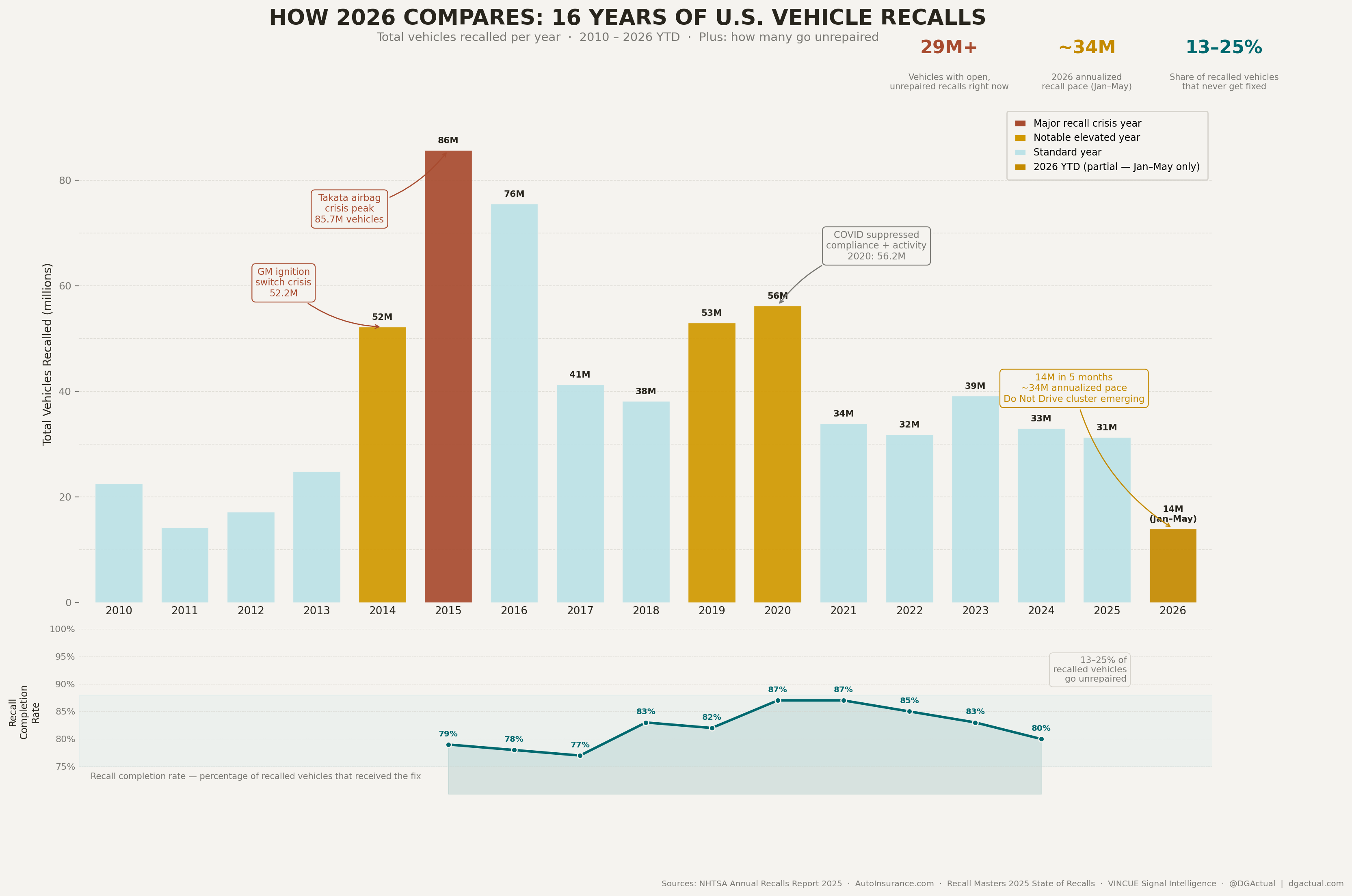
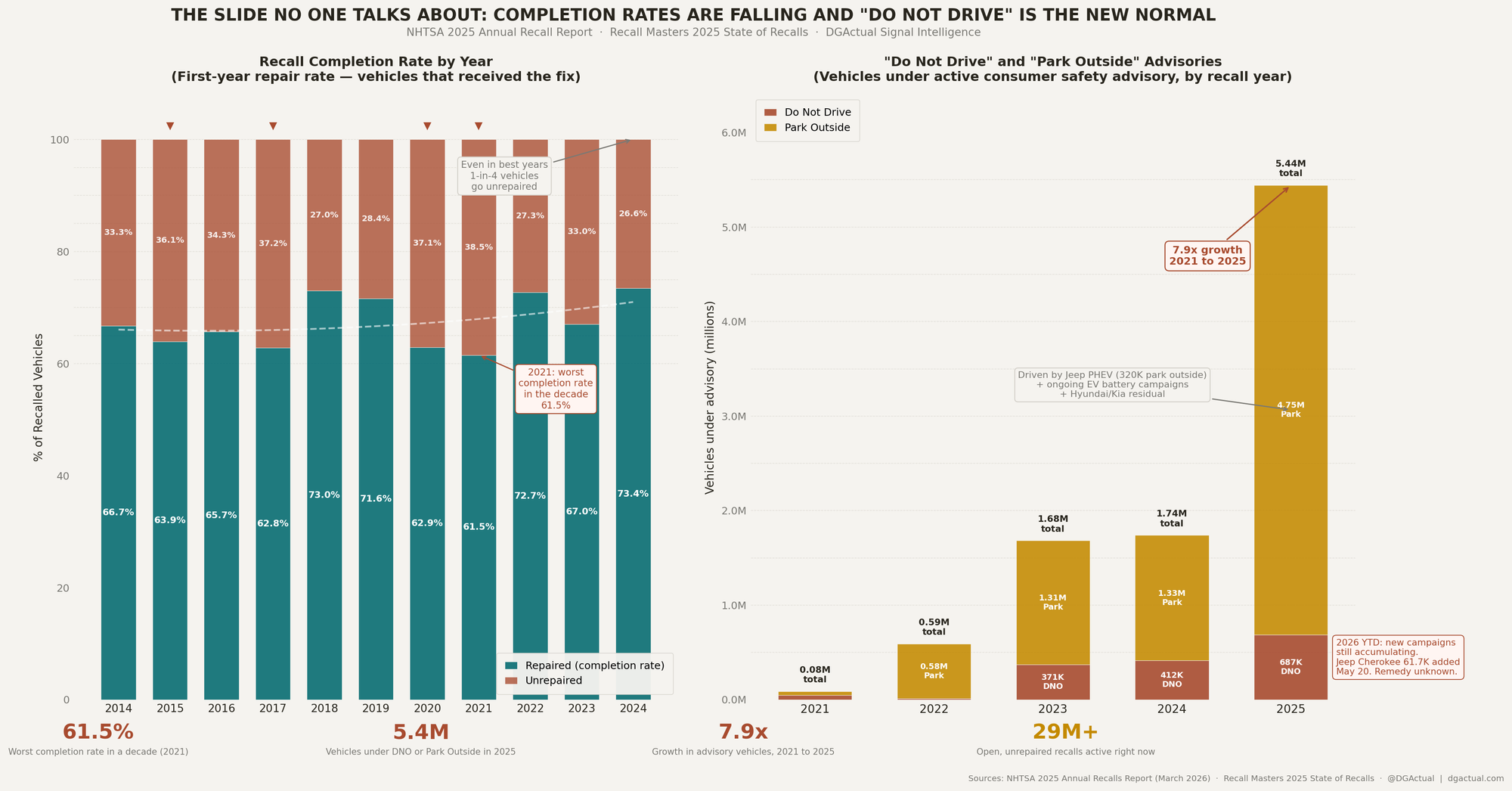
One in four vehicles on American roads right now has an open, unrepaired recall. Not historically. Right now, today, in 2026.
That is not a rounding error. That is 29 million vehicles. And the rate is not improving.
How We Got Here
The U.S. has averaged roughly 40 million recalled vehicles per year since 2014. The peak was 2015, when Takata airbag replacements drove 85.7 million units into campaign status. That felt like a once-in-a-generation event. It was. Until it wasn't.
First-year completion rates have oscillated between 62% and 73% for a decade. Even in the best years, one in four vehicles goes unrepaired twelve months after a campaign opens. In the worst years, closer to one in three. The math compounds. Old campaigns accumulate. Owners move. Vehicles change hands. Paperwork goes to a previous address and nobody follows up.
2026 is not a spike year by volume. The annualized pace sits around 34 million, right at the historical average. But something qualitative has shifted in a way that the volume numbers do not capture.
The Advisory Category That Did Not Exist Three Years Ago
NHTSA now tracks "Do Not Drive" and "Park Outside" campaigns as their own category in the annual report. That category did not exist in any meaningful sense before 2021. There were 84,097 vehicles under those advisories in 2021. By 2025, there were 5.4 million. That is a 7.9x increase in four years.
Do Not Drive used to be reserved for catastrophic, one-in-a-generation events. In 2026, it is a routine label appearing across six manufacturers in five months.
The Takata parallel gets cited often. What is different now is the source of the problem. Takata was a single supplier with a specific, well-understood chemistry failure. The 2026 advisory landscape spans battery management software, high-voltage pack replacement, mechanical drivetrain failures, and electrical systems in vehicles that are still rolling off the line.
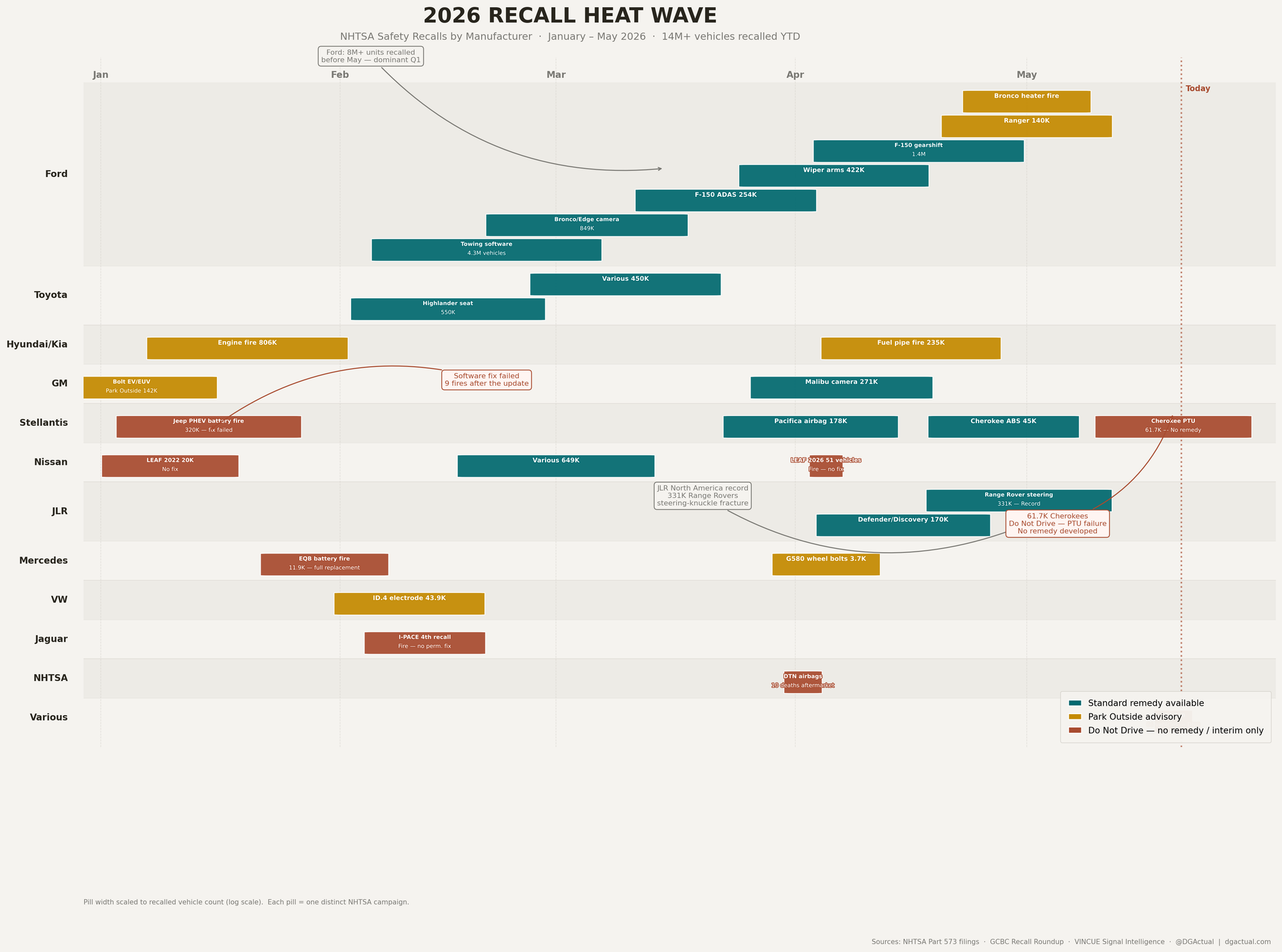
The Jeep PHEV Wrangler and Grand Cherokee situation is the clearest example. 320,000 vehicles. Battery fire risk while parked. A software update was issued in 2024. Nine vehicles caught fire after receiving the update. NHTSA's current advisory is still "Do Not Drive. Do Not Park in a Covered Structure." There is no permanent remedy.
The Jeep Cherokee 26V290, filed May 20, 2026, covers 61,711 vehicles with a PTU failure that can cause loss of motive power at any speed or rollaway in Park. Remedy not yet developed.
The Nissan LEAF 2022 campaign, 25V655, covers roughly 20,000 vehicles with battery fire risk during DC fast charging. The second interim notice went out in March 2026. There is still no fix.
The Mercedes EQB 2022-2024 campaign, 26V073, covers 11,895 vehicles where a prior software fix was deemed insufficient. The remedy is now a full high-voltage battery pack replacement.
The Jaguar I-PACE is on its fourth recall for the same battery fire issue. Interim software. No permanent fix.
This is not a bad year. This is a structural feature of the EV transition landing in the service drive at scale.
What This Means in the Lane
Ford crossed 8 million recalled units before May this year. The single largest 2026 campaign, 26C10, covers 4.3 million vehicles in a single electrical systems action. JLR's North American recall record fell in 2026 when 331,559 Range Rovers and Range Rover Sports were called back for steering-knuckle fracture risk.
These are not edge cases from obscure model lines. These are vehicles your service drive sees every week.
The fixed ops math on recall traffic is not complicated. Every campaign is OEM-reimbursed. Zero marketing spend required to generate the visit. Recall Masters data puts the average RO value on a recall visit above $625. Fifty-four percent of recall visits generate additional customer-pay work. That means the recall appointment is not just covered labor. It is a lead for the advisors who know how to handle it.
Completion rates decline as campaigns age. The older the open recall, the less likely the owner acts on it. Which means outbound contact on aged campaigns is not a compliance exercise. It is a fixed ops revenue strategy.
The Trade Desk Has a Role Here Too
A customer who owns a Jeep Cherokee under an active Do Not Drive advisory and no developed remedy is not a passive service customer. They cannot drive the vehicle. They cannot wait for a fix that does not exist yet.
That owner is a motivated seller. Appraise the trade before you write the repair order.
The appraisal has constraints. A vehicle under an active Do Not Drive advisory cannot be parked in a covered structure. It cannot be retailed as CPO. It cannot sit on your front line. You need to know what you are acquiring before you acquire it. VIN check before appraisal is not optional, it is the starting point.
The same discipline applies to off-lease turn-ins. More than 300,000 EVs are coming off lease in 2026. They include vehicles from the exact model years and brands currently under active battery fire campaigns. Build the VIN check into intake. Make it the first step, not an afterthought at titling.
The Pipeline Is Already Built
Every dealer who complains about declining service traffic is operating with 29 million open campaigns sitting in the market. Some of those vehicles are in your DMS. Some are in your PMA. Some are vehicles your own customers currently drive.
The traffic is not the problem. The capture rate is.
Recall completion is the only service category where the OEM has already committed to paying for the work, the customer has a documented reason to come in, and 54% of the time you leave money in the lane if you do not have a process for customer-pay upsell. That is the definition of a low-resistance revenue channel.
The car in your neighbor's driveway has a one-in-four chance of having an unfixed recall. Your trade capture rate on that vehicle depends entirely on whether you ask.
The recall economy is not coming. It is the current operating environment. The question is how much of it your store is capturing, and how much is aging out in someone else's driveway.
Daniel Govaer | EVP Product VINCUE | Loyalty Project Manager Beaver Toyota | Dealer Innovation Group Facilitator MyKaarma | Former Award Winning Mercedes-Benz General Manager | NADA Academy Class N367 Graduate