 DGactual
Right to Repair Is Coming. Here Is What It Actually Means for Your Service Lane.
The REPAIR Act passed committee 48-1. The telematics fight is unresolved. Massachusetts already won in court. Here is the full picture and what it means for your fixed ops revenue.
Here is a thought I keep coming back to. The dealerships winning the technician war right now are not winning it by offering more money. They are winning it because they are the only shops that can actually do the work. The complexity of a modern vehicle, the sensor calibration, the ADAS procedures, the OEM-specific tooling, has outpaced what most independent shops can train for fast enough. Dealers are pulling technicians from independents because the independents do not have the tools, the procedures, or the training to handle what is coming through the door.
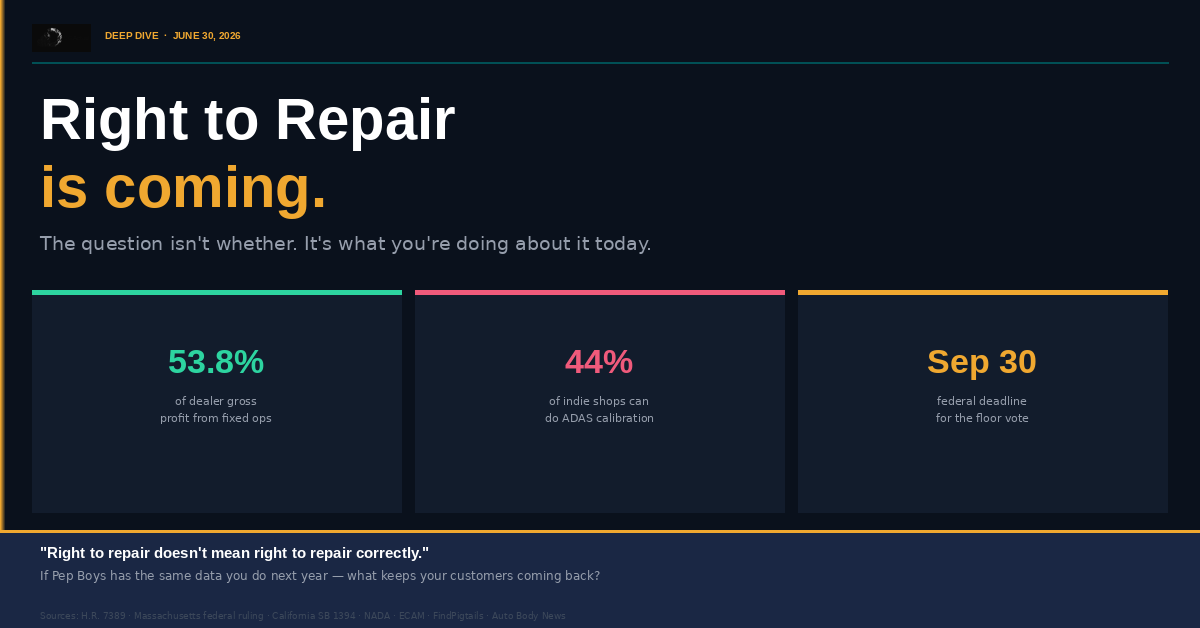
Right to repair doesn't mean right to repair correctly.
A shop can have data access. It can have the scan codes. It can know that the forward collision system needs recalibration after a windshield replacement. But knowing what needs to happen and having the equipment, the certified process, and the trained technician to do it safely are two different things. The legislation doesn't close that gap. The market does.
That advantage is real. And it is also temporary, if you let it be.
What is actually happening
On June 3, 2026, Trump met with Ford, GM, and the Alliance for Automotive Innovation at the White House and publicly said drivers should be able to fix their own vehicles. That is not the kind of statement a sitting president makes about a technical trade dispute unless the political winds have shifted far enough to matter.
The bill behind that meeting, H.R. 7389, passed the House Energy and Commerce Committee 48-1 in May. It codifies existing repair access agreements and gives the FTC enforcement authority. It has a September 30 deadline tied to the surface transportation reauthorization bill. Something is going to happen before September 30.
Here is what the bill does and does not do. It protects the right to plug a scanner into the OBD-II port. That was already the practice. What it does not yet cover is the wireless telematics stream, the cellular data your customers' vehicles transmit to OEM servers every time they drive. That part got stripped out. For now.
The full REPAIR Act with telematics provisions is still alive. Its sponsor is pushing to add it back on the House floor. The September deadline is when that fight happens.
The question you should be asking yourself right now
Ask yourself this:
"If Pep Boys has access to all of the same data and diagnostics as I do next year, what am I doing today to keep my customers coming back to me?"
A vice president at one of the major dealer technology platforms, after reading an early draft of this piece.
That is the right frame. Not whether right to repair passes. Not whether the telematics provisions make it into the final bill. Those are questions for lobbyists. The question for a dealer is: what happens to your service lane retention if the data advantage disappears?
The revenue that is actually at stake
The question right to repair creates for dealers is not whether independent shops will take your oil changes. They already have. The question is whether they will take your ADAS calibration work. And the answer is yes, they will, unless you do something about it today.
ADAS calibration is now required on 65% of collision repairs and 35.6% of all repair estimates. Average revenue per calibration: $250 to $500 per system, and most vehicles require multiple calibrations per repair. The ADAS calibration market is $280 million today and projected to reach $818 million by 2036. Only 44% of independent shops currently have the capability to do it.
That capability gap is your window. It is not permanent. Right to repair with full telematics access would allow independent shops to identify which vehicles need calibration and access OEM procedures. That is exactly the kind of workflow that the legislation, if it passes in full, would open up. The shops that will lose are the ones whose competitive advantage is data access rather than technical capability.
There is a parallel already playing out on the parts side. Ford sells Motorcraft parts and GM sells ACDelco parts through Walmart, often at prices at or below what franchise dealers can purchase them wholesale. A fixed ops director went public about it in 2024. The OEMs are already pricing their own parts against their own dealers at the retail counter. Right to repair with telematics access extends that same structural problem to the diagnostic and calibration layer. It is not a new dynamic. It is the same dynamic moving up the complexity stack.
Fixed ops now contributes 53.8% of total dealership gross profit, the highest share on record. Net pretax profit fell 11.2% year over year in Q1 2026. Fixed ops is carrying the store. This is not a peripheral issue.
Two states have already answered this question
Massachusetts voters passed expanded right to repair in 2020 with 75% approval. It required automakers to give owners and independent shops wireless telematics access starting with 2022 model year vehicles. Automakers sued. In February 2025, the federal court dismissed the lawsuit. The law stands. Enforcement began.
California went a different direction but made the same underlying point. Governor Newsom signed SB 1394 in September 2024, effective July 1, 2025, requiring automakers to disable connected vehicle access within two business days of a domestic violence survivor's request. The intent was narrow. The precedent is broad: a state government just established that connected vehicle telematics is a service that can be severed on demand, with a defined timeline, by legislative mandate. That is the same structural argument Massachusetts made for repair access. California applied it to safety. The principle is identical.
As of June 2026, automakers are asking California for a delay on SB 1394 because they are not ready to comply. The deadline pressure is the same story repeating: OEMs build connected vehicle infrastructure to serve their own data interests and then discover, too late, that the public and legislators have a different view of who owns that data stream.
Connecticut's law takes effect July 1, 2026. Texas follows September 1, 2026. Some form of right to repair legislation has been introduced in all 50 states. The direction is not in question. The timeline is.
The loyalty health check
The piece of this that does not get discussed enough: right to repair in any form is an invitation for your customer to try someone else. A loyalty program is what makes that invitation less interesting. Not a punch card. Not a points app. An actual system that gives customers a reason to keep their vehicle's service history at your store.
Here are the questions worth answering honestly:
- Do you know, by name, which customers in your service file have not been in for service in the last 12 months? Do you have an outreach plan for them, or just a DMS report no one reads?
- When a customer brings in a vehicle for a safety recall or a warranty repair, is there a defined process for converting that visit into a paid RO relationship, or does it end at the recall completion?
- If an independent shop opens three miles from your dealership and gains access to the same telematics data you have today, which of your customers leave and which ones stay? Do you know the difference between those two groups?
- What does a customer get from your service lane that they cannot get from a well-equipped independent? Training and tooling are part of the answer. What else is in the answer?
Those are not rhetorical questions. They are the business questions that right to repair forces into the open.
Where NADA stands and why it matters
NADA supports H.R. 7389 as passed and explicitly opposes adding the broader telematics provisions on the House floor. The stated concern includes insurer influence over repair decisions and cybersecurity risk. Both are legitimate. The unstated concern is competitive advantage. That is also legitimate.
The honest read: the current system, where dealers have telematics access and independent shops do not, is a competitive advantage that has nothing to do with safety and everything to do with market structure. NADA is protecting that structure. That is NADA's job. Your job is to figure out what your service lane looks like when that structure changes, because it will.
The service lane is where right to repair either costs you or doesn't. The law doesn't determine the outcome. You do.
Data access doesn't create loyalty. Technical capability earns trust. And a customer who feels genuinely connected to your service department doesn't need to be persuaded to come back. Build that relationship before September. Not because the legislation requires it. Because when the invitation to go somewhere else arrives, and it will, you want to have already answered it.
Sources: H.R. 7389 via CBT News | Trump meeting via Reuters | Massachusetts ruling via Auto Body News | California SB 1394 via Reuters | NADA position | OEM parts at Walmart via Auto Body News | Fixed ops gross profit via ECAM | ADAS calibration market via FindPigtails | State legislation via Morgan Lewis