 DGactual
Monday Signal Brief: Week of June 30, 2026
Payment wall at $813. Tariff floor defined. Hybrid prices at all-time highs. SAAR year-end call: 15.85M. Plus 3 open recalls your service lane should run this week.
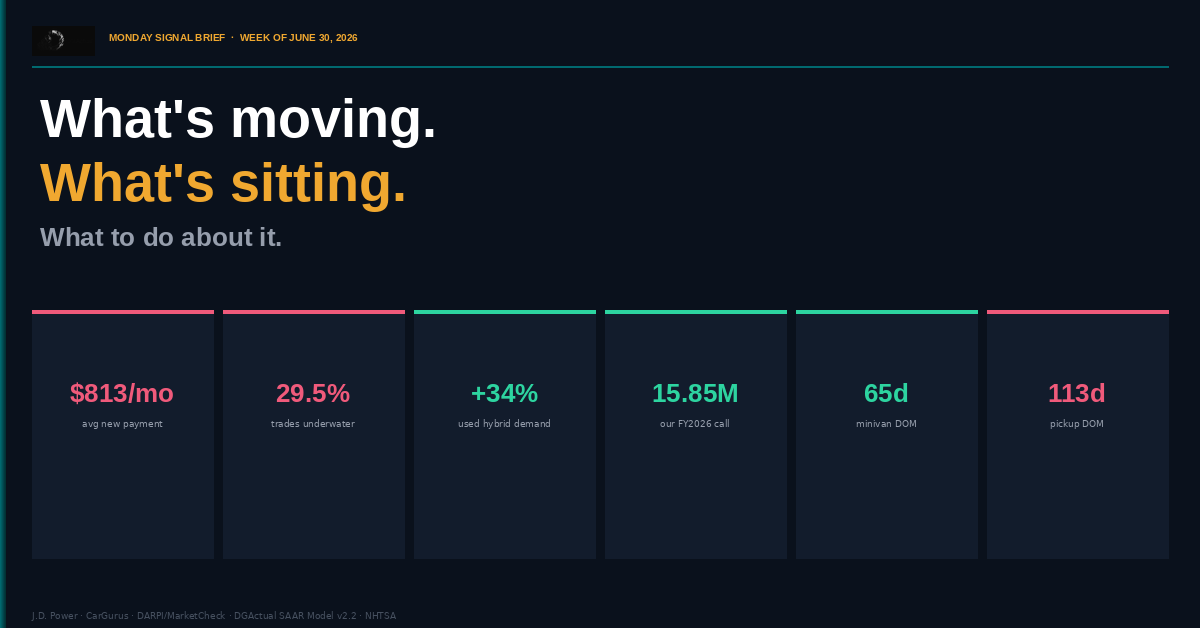
Here is what the signal data shows this week.
$813 a month and 29.5% upside down: the payment wall is real
J.D. Power and GlobalData put the average new-vehicle monthly payment at $813 in June, up 3.4% year-over-year. Average APR is 6.7%, the lowest June rate since 2022. June monthly pace: 16.5M annualized (total), retail 13.7M annualized, retail up 2.7% YoY. Incentives averaged $3,217 per vehicle, 6.2% of MSRP, up meaningfully from a year ago.
29.5% of trade-ins in June carried negative equity, up 1.4 percentage points year-over-year. Average negative equity: approximately $7,200. That means almost 3 in 10 trades walking through the door are upside down.
Tariff ceiling defined: 15% cap on auto parts for key trade partners
Section 232 auto parts tariffs are now capped at 15% all-in for Japan, Korea, the EU, the UK, and Taiwan. Domestic US-built vehicles are still absorbing $1,600 to $2,000 in steel and aluminum bleed-through costs. Fully imported vehicles face $5,000 to $8,900 in added tariff exposure.
For franchise dealers carrying Toyota, Honda, BMW, Volkswagen, Hyundai, or Kia, the parts-cost picture now has a defined ceiling. The uncertainty is lower, even though the cost is not zero.
Used hybrids at all-time price highs: up 34% in sales and $38,800 average list
CarGurus mid-year intelligence data shows used hybrid sales up 34% year-to-date. Average list price is $38,800, an all-time high for the segment, up 8.5% since early March. Demand is not softening.
DARPI data from this week independently supports it. Toyota is the fastest-moving mainstream brand on dealer lots right now at 76 days median DOM, faster than every other volume brand. Toyota’s mix is roughly 40% hybrid by current sales. Compact SUV and Midsize SUV, the two segments where most hybrid volume lives, turn at 88 and 92 days respectively. Full Pickup, which carries almost no hybrid penetration, sits at 113 days. The velocity gap shows up in our own data.
DARPI Week 3: minivans and EVs move fastest, trucks are slow but prices are firming
DARPI data via MarketCheck for the week of June 29 shows minivans at 65-day median DOM, $28,898 median asking price, the fastest-moving segment on dealer lots. Electric vehicles are second at 67-day median DOM, $34,220 median. Full-size pickups are the slowest major segment at 113-day median DOM.
Trucks index at 100.60, still the only segment holding above baseline. DARPI Near-New Index sits at 99.68, essentially flat at baseline. The retail vs. wholesale spread is -0.32 index points: retail dipped below wholesale for the first time since the index launched. Both series remain near baseline, so this is an early signal to watch, not a confirmed trend.
What the DARPI data is telling us this week
DARPI Week 4 (June 29, 2026) is a clean pull across all 9 active segments. Here is what the data shows, in plain language.
- Minivan is the fastest-moving segment on dealer lots at 65 days median DOM and $28,898 median asking price.
- Electric vehicles are second at 67 days DOM and $34,220 median. CarGurus data shows EV demand clustering in the $25,000 to $31,000 price band. The DARPI EV median of $34,220 sits above that band, so the affordable EV slice is what is moving fastest while higher-priced EVs sit longer.
- Full Pickup is the slowest major segment at 113 days DOM, yet it is the only segment still holding above the price baseline at index 100.60. Trucks are sitting and asking prices are not moving down yet.
- Luxury sits at 118 days DOM, the second slowest, at a $37,591 median. The P75 is $48,254.
- The retail vs. wholesale spread flipped this week. Retail is now 0.32 index points below the wholesale baseline, the first time retail has dipped below wholesale since DARPI launched. It is a four-week-old index and one data point is not a trend, but if retail keeps softening while wholesale holds, that is a margin-compression signal.
- DARPI Near-New Index: 99.68. The index moved from supply constraint to demand contraction this week. Not a collapse, a rotation.
Full interactive dashboard at data.dgactual.com. Updated every Sunday at 7 PM.
DGActual SAAR forecast: full-year 2026 at 15.85M, Q3 at 15.9M, Q4 at 15.2M
The DGActual Automotive Stress Monitor v2.2, updated June 26, 2026, puts our full-year 2026 base call at 15.85M SAAR, with Q3 projected at 15.9M and Q4 projected at 15.2M. That full-year number is a four-quarter average of the Q1 actual, the Q2 partial, and those two projections. It sits right on top of Cox Automotive’s 15.8M full-year forecast, so this is a consensus call, not a contrarian one.
The reason our average lands below J.D. Power’s 16.5M June monthly pace is timing, not disagreement. June is running fast. A fast single month does not set the full-year rate, and the second half of 2026 normalizes as the tariff pull-forward demand that lifted the first half runs out. What is left in the second half is real demand, not borrowed demand.
On the consumer side, UMich sentiment averaged about 48 in the second quarter (April 49.8, May 44.8, June 49.5), down sharply from the 60-plus readings of mid-2025. June’s 49.5 was the first monthly rise in four months, but it was still the second-lowest reading on record and the bump was driven almost entirely by falling gas prices rather than improving fundamentals. Model out-of-sample RMSE is 0.848M, and the uncertainty band is plus or minus 1.06M on any single quarter.
Leasing is the affordability answer we are walking away from
This one is personal, and I am going to say it plainly. We are shooting ourselves in the foot. As an industry we are letting leasing fade right at the moment our customers need it most, and we are backfilling the gap with 84-month loans. That is the wrong trade for the customer and the wrong trade for our future.
Look at where the numbers have gone. Leasing once made up roughly 30% of new-vehicle sales, but it has slid to about 20% in early 2026, and it bottomed near 16% in 2022 (Cox Automotive, via Finks). In its place, long-term debt has taken over: 84-month and longer loans hit 22.9% of financed new-car purchases in Q1 2026, an all-time high, up from 21.2% a year earlier (Edmunds). More than a third of all new loans, 35.55%, now run past six years, up from 30.83% the year before (Experian, State of the Automotive Finance Market, Q1 2026). We are stretching people out to seven years to chase a monthly payment.
Here is why that matters for the affordability story in the section above. The average new payment is $813 and 29.5% of trade-ins are underwater by about $7,200. An 84-month loan makes both of those worse. The longer the term, the longer the customer sits underwater, because the loan balance falls slower than the vehicle depreciates. Seven years of payments is seven years of negative equity risk, and it is the exact mechanism feeding that 29.5% number.
Leasing answers the same affordability question from the other direction. The payment gap between leasing and financing the same vehicle widened to about $151 a month in Q1 2026 (Experian), so a lease is a real lower monthly answer, not a gimmick, especially with the lease subsidies OEMs are running this year. The average lease runs about 37 months (LendingTree). At the end of that term the customer hands the keys back and walks away clean. Whatever depreciation gap would have shown up as negative equity on a loan is closed out by the residual, not carried into the next deal. Leasing does not let negative equity compound. It resets it.
There is a forward case too. Roughly 2.4 million vehicles come off lease in 2026, and J.D. Power expects lease volume to climb back toward its historical 30% (El-Balad; J.D. Power, via Credit Union Daily). Those returns are clean, late-model, one-owner units that flow back to us as certified inventory and bring the lessee back into the showroom on a known cycle. A lease is a customer who comes home every three years. An 84-month loan is a customer locked out of the market for the better part of a decade.
So here is what I would do, starting today. Lead with the lease where the lease genuinely wins, present it on the menu beside the finance option instead of burying it, and stop treating the 84-month loan as a normal close. A lease is a legitimate tool and I will never tell you it is not. Right now it is also the single most important initiative we can start to protect our customers and our own future. The difference is not really $151 a month. It is whether the customer is building toward their next vehicle with us, or just renting the use of this one while the equity hole gets deeper.
Open recalls worth running this week
Source: NHTSA Part 573 reports via weekly recall log.
Ford Focus (2012-2018), 255,404 vehicles. Engine can stall unexpectedly while driving. The fix is a PCM software update. This is a re-recall of a prior repair, affecting a high-volume VIN population.
GM full-size trucks and SUVs (2026 Silverado/Sierra 1500, Tahoe, Suburban, Yukon, Escalade and select 2015-2020 SUVs with replacement transfer cases). DO NOT DRIVE advisory. The transfer case can lock the wheels without warning.
Hyundai Tucson, Tucson Hybrid, Tucson Plug-In Hybrid (MY2025-2026), 96,310 vehicles. The instrument panel display can reboot or go blank while driving. Software fix, on a current-generation high-volume model.
That is the signal for this week. More in your inbox and at dgactual.com.