 DGactual
The FTC Is Coming After Car Dealers With a 112-Year-Old Law. Here's How a Payday Lender Made It Possible.
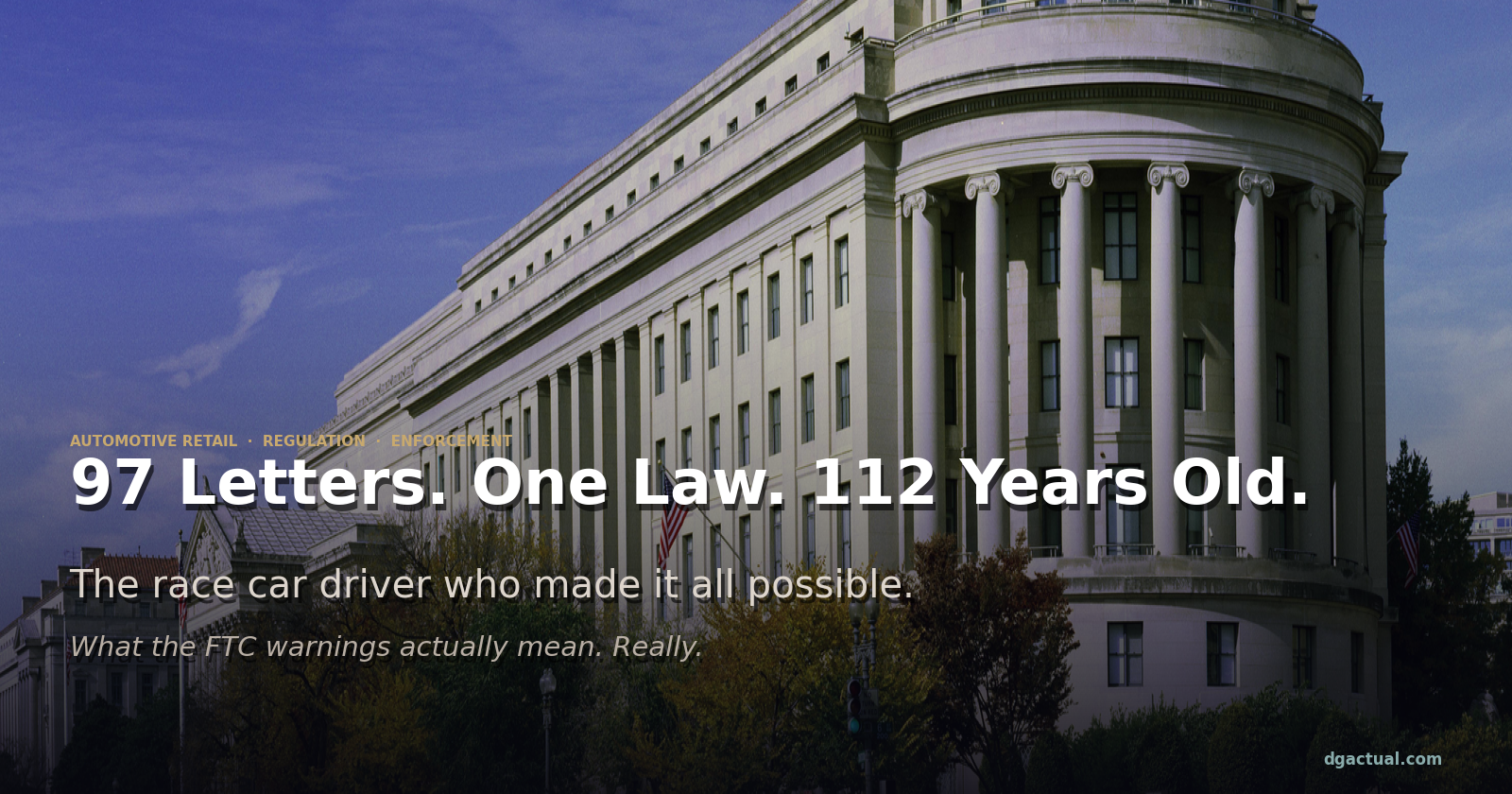
A Kansas City race car driver accidentally handed the FTC its most powerful tool against car dealers. A 112-year-old law, a unanimous Supreme Court ruling, 86,000 consumer complaints, and 97 warning letters. Here is the full story.
*By Daniel Govaer*
*EVP Product, VINCUE · Loyalty Project Manager, Beaver Toyota · Dealer Innovation Group Facilitator, MyKaarma · Former Award-Winning Mercedes-Benz General Manager · NADA Academy Class N367*
*~ 10 min read*
His name was Scott Tucker. He was a race car driver from Leawood, Kansas. He wore fire suits on weekends and ran an internet payday loan empire during the week.
Between 2008 and 2012, Tucker's companies, operating under names like Ameriloan, OneClickCash, and 500FastCash, issued more than 5 million short-term loans. The scheme was precise. A customer borrowed $300. The written disclosure said they could repay $390. Clean. Simple. Done.
Except it wasn't.
Buried in the loan documents was an automatic renewal clause. Unless the customer actively opted out, the loan renewed. And renewed. And renewed. That $390 total became $975. The customer paid more than twice what the document showed, because the document showed one thing and the actual obligation was another.
The FTC sued Tucker in 2012 under Section 13(b) of the FTC Act. The district court agreed. Tucker was ordered to pay $1.27 billion in equitable monetary relief. The largest consumer protection recovery in agency history.
Then it went to the Supreme Court.
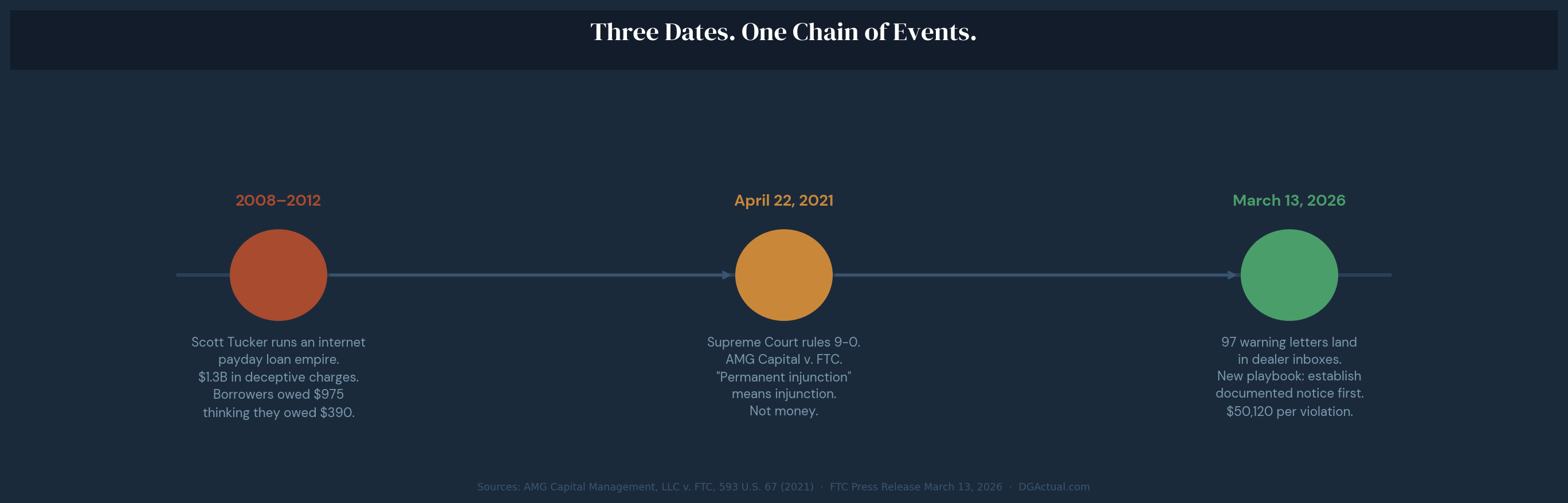
On April 22, 2021, nine justices, unanimous, reversed. Justice Breyer wrote the opinion. AMG Capital Management, LLC v. FTC, 593 U.S. 67 (2021). The holding: Section 13(b) says the FTC can seek a "permanent injunction." That means an injunction. It does not mean money. It never meant money.
FTC Acting Chairwoman Rebecca Kelly Slaughter called it a ruling "in favor of scam artists and dishonest corporations."
A payday lender from Kansas City accidentally changed how the federal government can police car dealers. Forever.
Here is why that matters for the 97 warning letters sitting in 97 dealer inboxes right now.
Section 5 Is Still Alive
After AMG Capital, the FTC's playbook needed a rewrite. What it had left was Section 5 of the FTC Act. Enacted in 1914. Older than the FM radio. Older than sliced bread. Older than the Model T's first full year of mass production. A 112-year-old prohibition on unfair or deceptive acts or practices that has sat in federal law since before anyone now alive was born — and has never been weakened by AMG Capital, never touched by the Fifth Circuit, and is fully operational right now.
Then came the CARS Rule. The Combating Auto Retail Scams Trade Regulation Rule, finalized January 2024, would have created specific binding regulations. On January 27, 2025, the Fifth Circuit vacated it. Not because the underlying practices were legal. The court expressly declined to rule on that question. It vacated the rule because the FTC skipped a required procedural step: the Advance Notice of Proposed Rulemaking. A process foul. The substance never reached the merits.
So here is what the FTC has left: Section 5, fully intact, fully operational.
And here is the strategy they built around it.
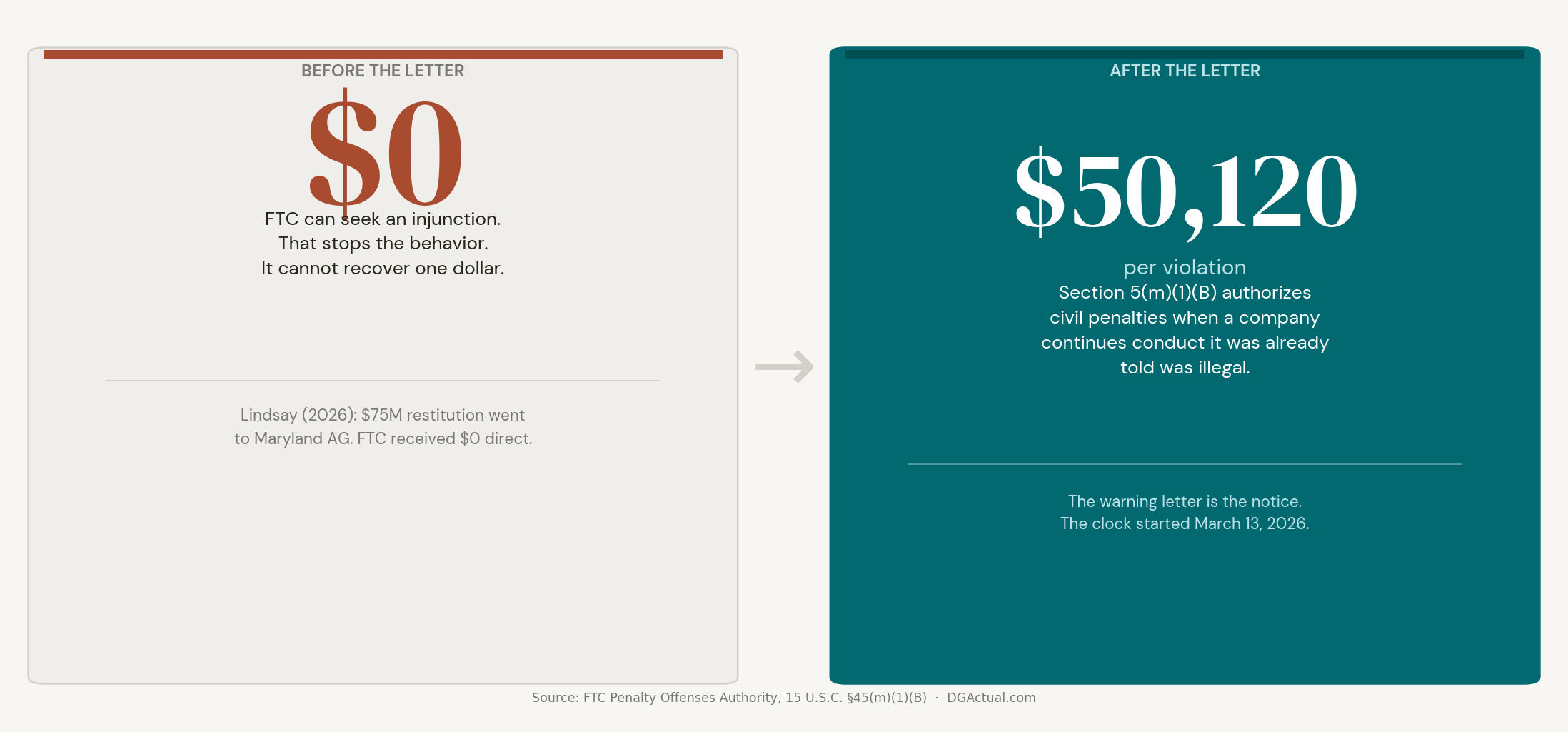
Under Section 5(m)(1)(B) of the FTC Act, the FTC can seek civil penalties against any company that engages in conduct the company knew was prohibited. The penalty: up to $50,120 per violation.
The warning letter is the legal mechanism that creates that knowledge.
Before a dealer receives the letter: the FTC can seek an injunction. No money. Not for a first-time Section 5 violation.
After a dealer receives the letter: up to $50,120 per transaction where violations continue.
The 97 warning letters sent on March 13, 2026 are the legal on-ramp to penalty exposure for any dealer who keeps doing what the FTC says they were already doing.
This is the post-AMG, post-CARS-Rule FTC enforcement playbook.
The Letters Themselves
Every single letter is word-for-word identical in substance.
Same six practices. Same body text. Same three enforcement cases cited in the footnotes. The only differences: the recipient's name, address, and sequential footnote numbering.
The FTC released all 97 letters. Read one, you've read them all. The six practices:
- Advertising a price that does not reflect all required fees
- Advertising a price that reflects rebates or discounts not available to all consumers
- Advertising a price that fails to account for an additional required down payment
- Conditioning the advertised price on consumers using dealer financing
- Requiring consumers to buy additional items not reflected in the advertised price
- Advertising unavailable or nonexistent vehicles
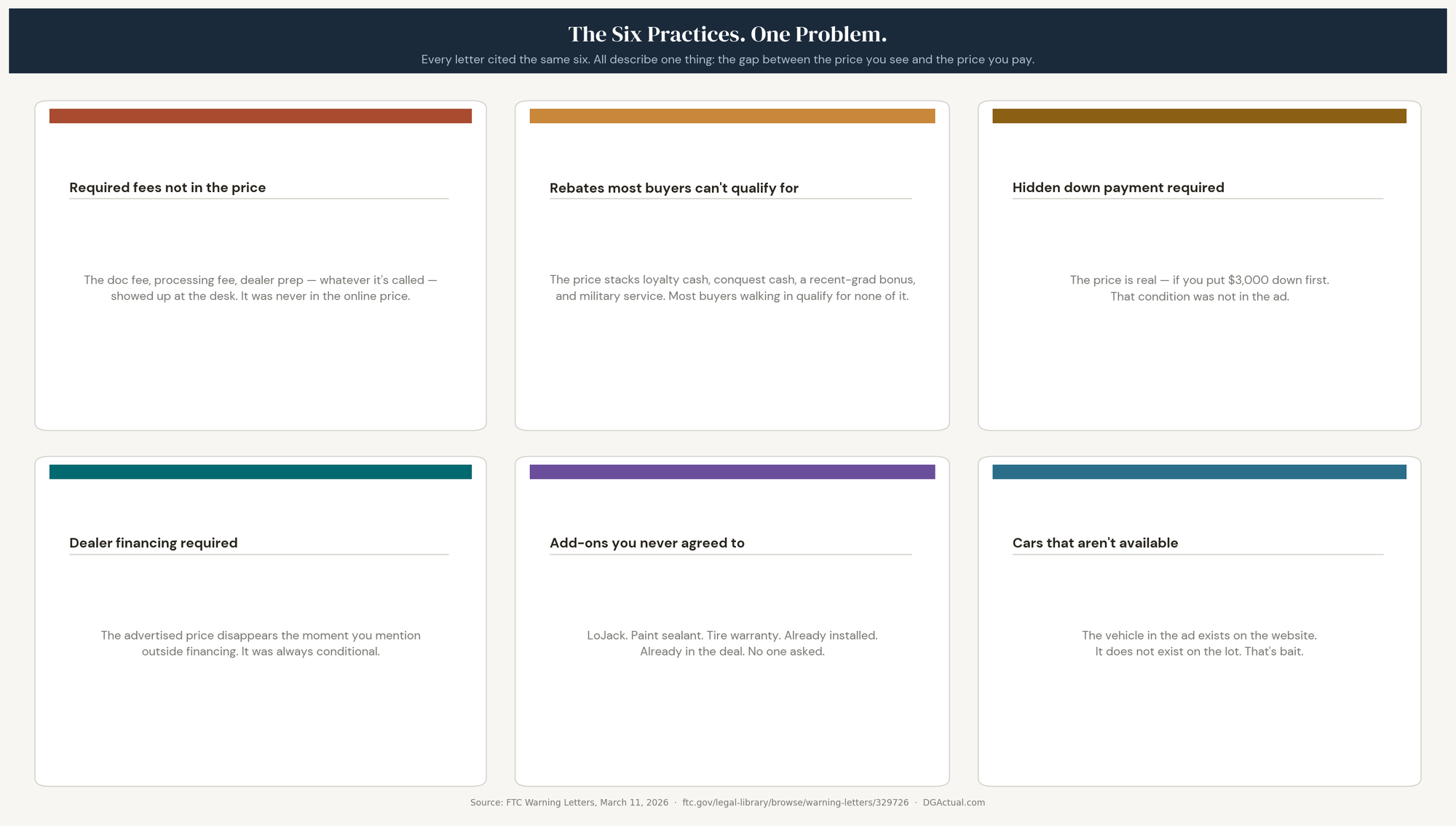
Six practices. One shared problem: the gap between the price advertised and the price collected.
The footnotes cite three active enforcement actions: Lindsay Automotive Group, Leader Automotive Group, and Asbury Automotive Group. Not hypothetical guidance. Live cases with real money and real injunctions.
85% Are Franchise Dealers. Here's Why That's Interesting.
Of the 97 dealers on the list, 82 are franchised new-car dealers. Fifteen are independent or used-car operations.
That 85% franchise concentration matters. The FTC's letters came from "significant patterns of complaints" in the FTC Sentinel database. Consumers who know they have a complaint, and know how to file one, file one. The franchise dealer universe is where most new-car transactions happen, and where consumers have an advertised price to compare against.
Among the 82 franchise dealers: four publicly traded groups received letters. AutoNation (AN). Group 1 Automotive (GPI). Lithia Motors (LAD). Sonic Automotive (SAH). Berkshire Hathaway Automotive, Warren Buffett's dealer group, is on the list.
Notably absent: Asbury Automotive Group (ABG) and Penske Automotive Group (PAG). Asbury already has a full administrative enforcement action in litigation, filed August 2024. You don't send a warning letter to a company you're already suing. Penske does not appear.
The warning letter is not a verdict. It is documented notice.
The Nissan and Stellantis Question
This is the part that deserves real attention.
The FTC's letters contain two layers. The group-level letter — 97 corporate entities received notice. And the cc: section naming specific individual rooftops within those groups that the complaint data pointed to. We read all 97 PDFs directly from ftc.gov.
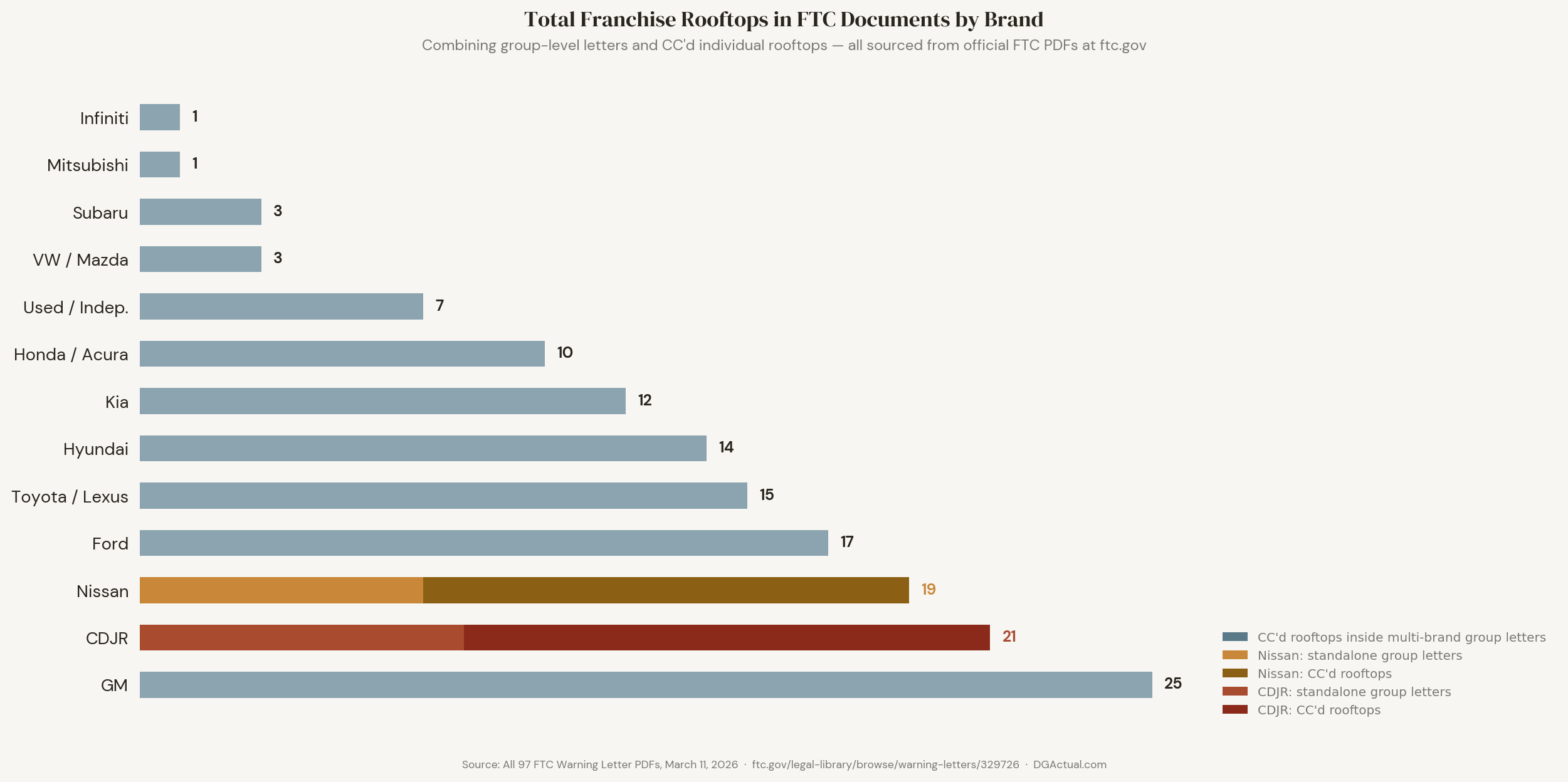
133 individual rooftops appear across the 97 letters. Nissan: 7 standalone group letters plus 12 CC'd rooftops inside other groups' letters — 19 total Nissan locations across 9 different dealer groups. CDJR: 8 standalone group letters plus 13 CC'd rooftops — 21 total CDJR locations across 9 different dealer groups.
The complaint data did not stay at the corporate level. It pointed to specific addresses, in markets across the country, under different ownership structures. Both brands appear consistently across the list — not as isolated cases.
The MAP pricing question
To understand why, you need to understand MAP pricing. A 2020 Maryland legislative testimony document from the Auto Consumer Alliance lists the OEMs with Minimum Allowable Advertised Price guidelines: Cadillac, Honda, Lexus, Mazda, Mercedes-Benz, Nissan, Subaru, Toyota, and Volkswagen. Stellantis brands — Chrysler, Dodge, Jeep, Ram — are not on that list.
What MAP means: a dealer cannot advertise below a set price floor without losing co-op funds or awards. The actual transaction price can be lower. But what gets published must stay at or above MAP. Without a MAP floor, a dealer can advertise any number. Any number that makes the phone ring.
The Nissan picture
Nissan has MAP. And 19 Nissan locations appear in FTC documents. The tension is in the incentive stack. Nissan's stair-step program layers conquest cash, loyalty rebates, regional programs, and fleet incentives on top of each other. A dealer advertising a Nissan at $X may be building in incentives that only a fraction of walk-in buyers can access. The advertised price is technically achievable. For most buyers, it isn't. That is exactly what practice number 2 describes.
The Nissan One program, launched June 3, 2025, was called "one of the most damaging programs in the company's history" by a group of dealers who threatened coordinated legal action in December 2025. Details: CDG News, December 19, 2025.
The Stellantis picture
No MAP pricing. At all.
Stellantis reported a net loss of 22.3 billion euros for 2025 — the first annual loss in company history. Seven consecutive years of declining US sales. Market share from 12.5% to barely 8%. Dodge posted a 28% sales collapse in 2025. Cox Automotive data via Carscoops: Dodge at 142 days supply, Chrysler 135, Ram 135, Jeep 128. Industry average: 78 days. Toyota: 36.
Without a MAP floor, a dealer facing 142 days of inventory and a 28% sales collapse has a structural incentive to advertise the sharpest number possible. Whether every buyer can get that number is the FTC's question.
No conclusions. The data is sourced from official FTC documents and public financial reporting.
What Happened When the OEM Was Watching
When I ran Mercedes-Benz stores, pricing compliance was not something we managed in isolation. Mercedes-Benz, like most MAP-program OEMs, monitored it for us.
That is the reality of the franchise relationship at brands with active MAP infrastructure. The OEM has co-op funds at stake. They have brand standards to protect. A pricing violation at one of my stores did not have to reach the FTC Sentinel database to get flagged. The OEM would catch it first.
The DemandLocal OEM compliance guide documents this across brands. Toyota runs a three-strike system: first violation means loss of trip eligibility and awards, second triggers suspended marketing support, third brings enhanced monitoring. Honda maintains strict below-invoice advertising prohibitions with active third-party platform monitoring.
That compliance machinery is a first line of defense the FTC never has to touch.
One clarification worth stating directly: the FTC's authority is independent of OEM franchise agreements. A dealer can be in full compliance with their OEM's advertising standards and still violate Section 5 of the FTC Act. These are parallel systems with different standards.
The implicit observation: brands with active MAP programs and OEM compliance infrastructure have a system that surfaces pricing issues before a consumer complaint reaches federal regulators. Brands without that infrastructure have no such buffer.
What the Letter Actually Does
This is the part that matters most.
Before this letter, if the FTC caught a dealer violating Section 5, the only remedy was an injunction. No fines. No restitution. The Supreme Court eliminated the FTC's ability to collect money directly in AMG Capital Management v. FTC (2021). That ruling is why the $75 million in Lindsay consumer restitution went to the Maryland Attorney General's office, not the FTC. The agency got nothing direct.
After this letter, that changes. Section 5(m)(1)(B) allows civil penalties of up to $50,120 per violation when a defendant had documented notice that the conduct was deceptive. The warning letter is that notice. The moment it was received, the penalty clock started.
Before the letter: injunction only. No money.
After the letter: up to $50,120 per transaction where the practice continues.
A dealer running 200 transactions a month with a systematic pricing gap does that math fast.
The three enforcement cases in every letter's footnotes are not background reading. They are the FTC showing each recipient what full enforcement looks like.
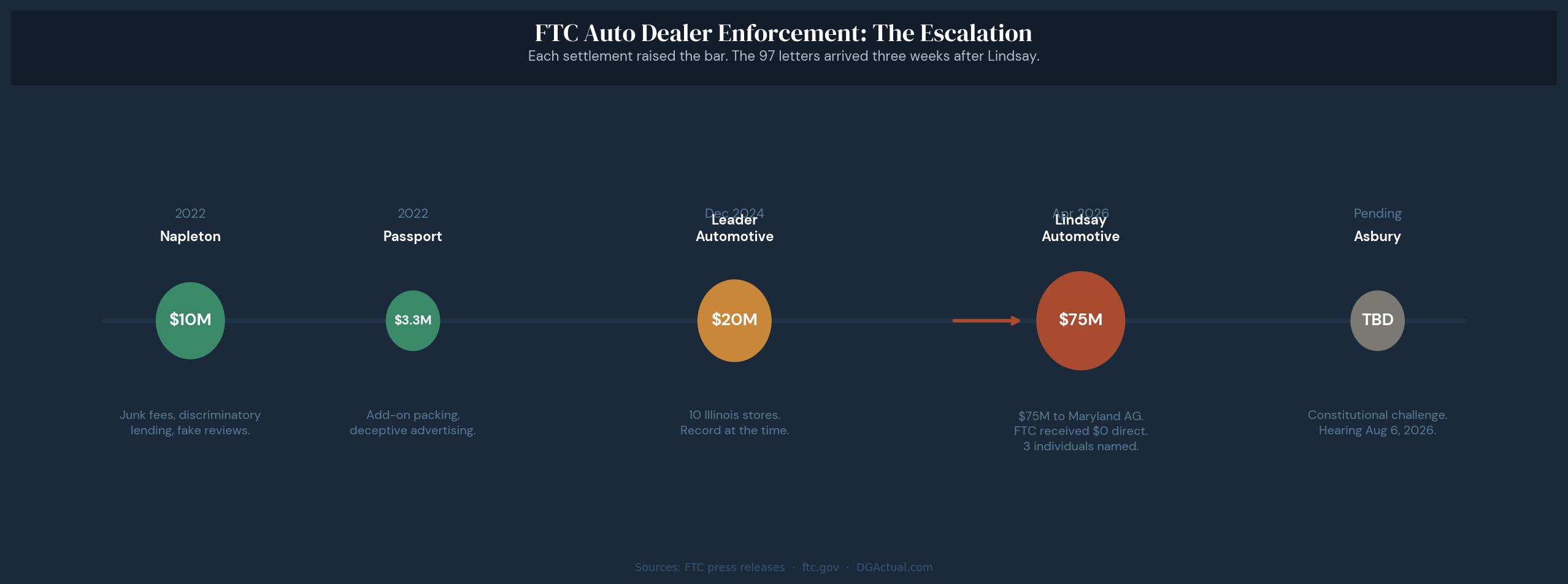
Lindsay Automotive: 88% of buyers paid more than $2,000 over the advertised price. 68% were charged for at least one add-on they didn't consent to. $75 million in consumer restitution. $3.1 million civil penalty. Three individuals named personally. Owner, COO, and a former GM.
Leader Automotive: $20 million. Bait-and-switch internet pricing, mandatory pre-installed add-ons, fake reviews to suppress consumer complaints. Ten Illinois stores. The VP of U.S. operations was charged separately.
Asbury: Still in litigation. Three Texas stores. Constitutional challenge to FTC administrative authority pending. Hearing set for August 6, 2026.
One more piece of context: the FTC's CARS Rule, which would have codified these disclosure requirements as binding regulation, was vacated by the Fifth Circuit in January 2025 on a procedural defect. The rule is gone. The warning letter strategy is partly the FTC's answer to losing that rulemaking path.
What Compliance Looks Like at the Desk
The rule is simple to state: the advertised price is the price any consumer can pay, excluding only government-imposed fees like taxes and title. Everything else, doc fees, processing fees, freight, dealer prep, goes in the number. Not the footnote. In the number.
A price that requires dealer financing to access is not the price. A price built on incentive stacking that most buyers can't qualify for is not the price.
Add-ons require express consumer consent before the charge appears. "We do this on every car" is not consent.
Social media pricing is not exempt. An Instagram post with a price is an advertisement. A third-party platform listing is an advertisement. The digital footprint is permanent and searchable.
One other dynamic: peer reporting is real. Compliance failures at a competitor can surface through customer complaint databases faster than most dealers expect.
The Database Behind the Letters
The FTC's Consumer Sentinel Network received 6.5 million consumer reports in 2024. It is the largest consumer fraud and complaint clearinghouse in the United States.
Auto dealer fraud complaints in that database: 60,189 in 2024. Then 86,000 in 2025. A 43% surge in a single year, per reporting from F&I and Showroom citing Consumer Federation of America data. Automobile-related complaints have topped the Consumer Federation of America's annual complaint ranking for nine consecutive years. Not phones. Not banks. Not healthcare. Cars.
The 97 warning letters were not random. They came from the most complained-about consumer industry in America, in a database that collected 86,000 automotive fraud reports last year alone. The FTC did not go looking for a fight. The complaints built the case.
The One Question the FTC Hasn't Answered
The letters state they were triggered by "significant patterns of complaints" in the FTC Sentinel database. Consumer complaints reflect who filed reports, not necessarily who had the highest underlying rate of the practices described.
Is it reasonable to assume the 97 dealers on the list were the only ones engaged in the six practices described?
The FTC has not answered that question. Its selection criteria are nonpublic.
The warning letters represent documented knowledge for 97 operators. The practices they describe did not originate on the date of the letters.
That is not an accusation. It is the question the data asks.
Sources
- AMG Capital Management, LLC v. FTC, 593 U.S. 67 (2021)
- FTC Chairwoman Statement on AMG Capital, April 22, 2021
- Fifth Circuit CARS Rule Vacatur, No. 24-60013, January 27, 2025
- FTC Penalty Offenses Authority, Section 5(m)(1)(B)
- FTC Press Release — 97 Auto Dealership Groups, March 13, 2026
- All 97 Warning Letters — ftc.gov Primary Source
- Napleton Automotive FTC Settlement, April 2022
- Leader Automotive FTC Settlement, December 2024
- Lindsay Automotive FTC and Maryland AG Settlement, April 2026
- Asbury Automotive FTC Case, Matter No. 222-3135
- Maryland Auto Consumer Alliance — MAP Pricing Testimony, January 28, 2020
- Nissan Dealer Backlash — CDG News, December 19, 2025
- Stellantis 2025 Net Loss — MotorTrend, May 2026
- Stellantis Days Supply by Brand — Cox Automotive via Carscoops, May 26, 2026
- Dodge 2025 Annual Sales Results — Motor1
- OEM Compliance Monitoring Frameworks — DemandLocal, 2025
- FTC Auto Dealer Complaint Data — F&I and Showroom, May 12, 2026
- FTC Dealer Advertising Compliance — Charapp & Weiss, 2026
- FTC Names 97 Dealerships Warned — CBT News, May 29, 2026
*Daniel Govaer is EVP Product at VINCUE, Loyalty Project Manager at Beaver Toyota, Dealer Innovation Group Facilitator at MyKaarma, former award-winning Mercedes-Benz General Manager, and NADA Academy Class N367 Graduate.*