 DGactual
DGActual Market Brief — Week of July 27, 2026
Prices fell for the second straight week. Negative equity hit a Q2 record. Polestar exits the U.S. Canada tariff in 23 days. Five days of dealer earnings start Tuesday.

Used vehicle prices fell for the second straight week, Midsize Car led the decline at down 1.8%, with Compact SUV, Compact Car, EV, and Luxury SUV all softer. The only two high-volume models moving in under 40 days are Tesla Model Y and Model 3. Ford F-150 private sellers are asking $2,575 above dealer asking price and sitting 110 days to get it, motivated sellers are forming. Negative equity hit a Q2 record: 29.6% of new-vehicle buyers rolled in an underwater trade, averaging $6,884 shortfall. Polestar is fully exiting the U.S. market. Cadillac is reversing its all-EV commitment. Earnings week runs all five days, Asbury through AutoNation, and will be the clearest read on how the industry is pricing Q3.
Top stories
Five days of dealer earnings, what to watch
Every major public dealer group reports this week. Asbury Automotive goes Tuesday. Penske Automotive, Carvana, and Lithia Motors all report Wednesday. Sonic Automotive and Group 1 Automotive on Thursday. AutoNation closes the week Friday morning.
The two numbers that matter most in every call: used vehicle gross profit per unit and service absorption rate. Front-end new car gross has been compressing for two quarters. The groups that are holding margin are doing it through fixed ops and disciplined used car operations, not through new vehicle volume. If a group's service absorption is below 70%, their used GPU is under pressure, and their Q3 guidance is cautious, that is a stressed store model showing in public numbers.
Carvana is the wildcard. Their Q1 showed improving unit economics but the negative equity environment creates pressure on their trade-in acquisition model at scale. Watch what they say about acquisition cost per unit.
Negative equity hit a Q2 record, and it is sitting in your service drive
29.6% of new-vehicle buyers in Q2 2026 rolled negative equity into their new loan, according to Edmunds. The average amount underwater was $6,884. The average monthly payment for those buyers was $944, versus $777 for buyers without negative equity. Projected interest cost over the life of the loan: $16,270 versus $9,811.
That math compounds fast. A buyer who rolled $6,884 underwater into a 72-month loan at current rates is paying roughly $140 per month extra just to carry the previous vehicle's deficit. They will be back. These are not bad customers, they are customers who made a deal in a different market and are now stuck. The store that builds a relationship with them now, through service retention and a transparent trade evaluation, earns the next transaction.
Polestar is leaving the U.S. market, not winding down, exiting
Polestar will not contest the U.S. ban and is fully exiting the American market. This is not a temporary pause. Dealers who hold Polestar franchise agreements are in an uncertain position, and the used vehicle implications are immediate.
Parts and service availability for Polestar vehicles in the U.S. will become a question without a clear answer. If you are appraising a Polestar at trade-in, the lack of a domestic OEM service infrastructure needs to be factored in, not as a reason to pass, but as a reason to price conservatively. Retail buyers will ask about it. The answer matters to resale.
50% Canada tariff takes effect August 19, 23 days away
The White House proclamation imposing an additional 50% ad valorem duty on certain Canadian-origin products becomes effective at 12:01 AM ET on August 19. The affected product list is in Annex II of the proclamation, not all vehicles qualify, but Canadian assembly plants supply a meaningful share of North American production across Ford, GM, Honda, and Toyota lines.
If you have Canadian-sourced new vehicle orders in the pipeline, your OEM rep should be able to tell you exactly which VINs are affected and whether pricing is locked. Dealers who have not had that conversation yet have 23 days. The stores that get caught flat-footed will be the ones who assumed the OEM would handle it.
Cadillac is bringing gas models back, what it means for CPO
Cadillac has reversed its all-electric commitment. New gas-powered models are arriving in 2027, confirming that the brand will continue selling ICE vehicles alongside its EV lineup.
For dealers, the near-term implication is CPO supply. The assumption that ICE Cadillac inventory would thin out over the next two years is no longer valid. The off-lease and trade-in pipeline for CT4, CT5, and Escalade ICE vehicles will remain active longer than previously modeled. Price accordingly, the supply floor is not pulling away.
Price is beating brand loyalty, and most buyers walk in skeptical
Urban Science's latest Harris Poll study found that buyers are spending more time researching before visiting a store, visiting fewer stores before buying, and choosing value over brand loyalty at a higher rate than previous years. 42% of buyers said they have confidence in dealerships, up from prior years, but still below half.
The stores showing up in the data as winning July, Honda Marysville is one cited example, with fixed ops and a strong used operation described as powering a "surprisingly good" month, are not winning on new car traffic. They are winning because service retention builds the appraisal relationship, and a trusted appraisal desk converts buyers who started the research online. The first visit is earned before the customer walks in.
Volkswagen cut its 2026 revenue forecast
Volkswagen trimmed its full-year 2026 revenue guidance due to U.S. tariff pressure and intensifying competition from Chinese automakers in key export markets. For U.S. dealers, the watch item is CPO pricing and incentive structure on VW and Audi over the next 60 days. When an OEM is under margin pressure, the incentive line tends to move before the MSRP does.
Used vehicle market data, this week's buy recommendations and acquisition desk
The DARPI Retail Price Index updated Sunday with fresh data across 11 segments and 40 million-plus active dealer listings. This week's full report covers which models to prioritize when you see them, which private sellers are priced to move, and the full segment-by-segment breakdown with top models by volume and days on lot.
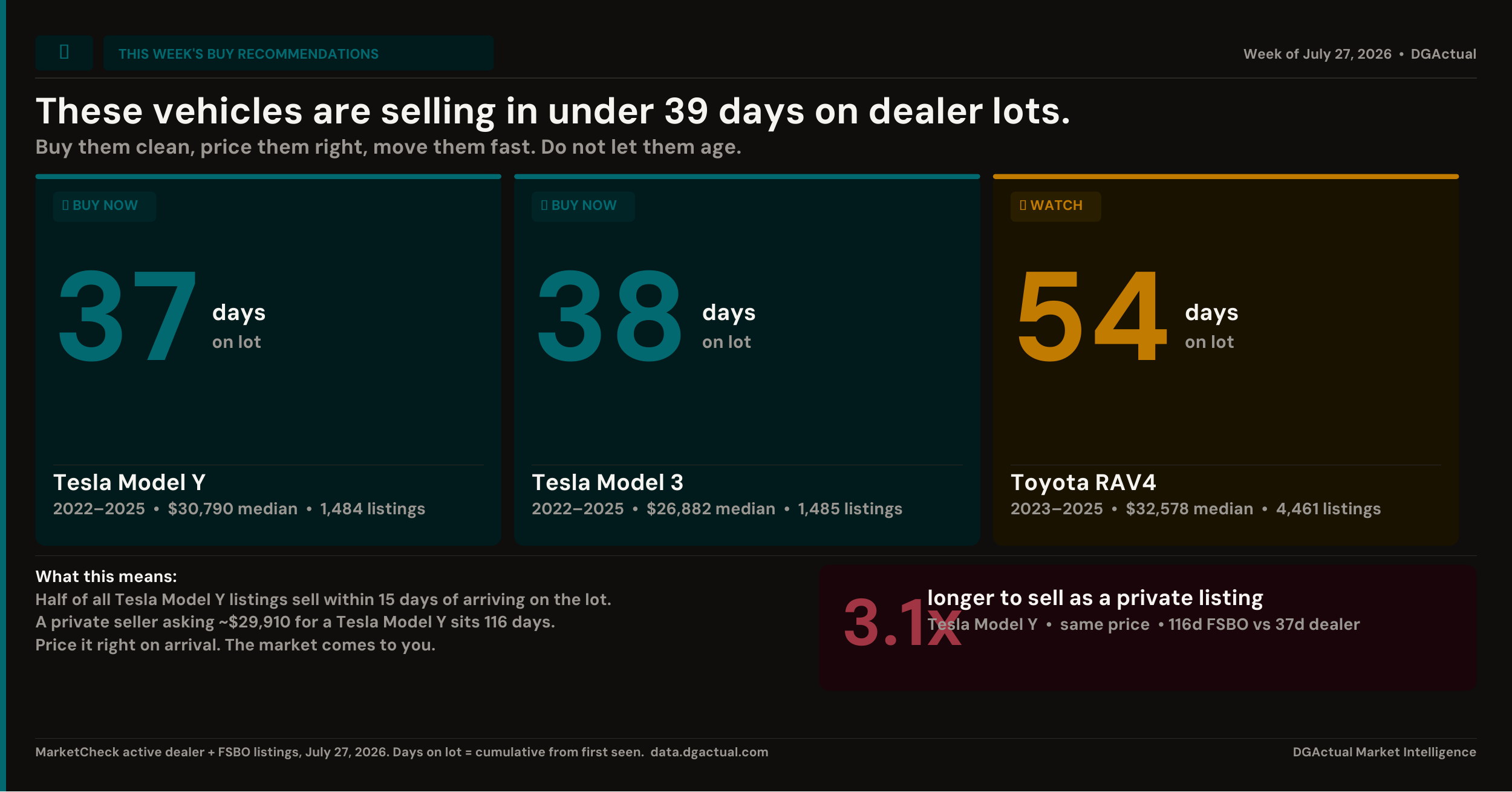
Tesla Model Y and Tesla Model 3 are the only high-volume models under 40 days on dealer lots. Half of all Model Y listings sell within 15 days of arriving. Toyota RAV4 is approaching 50 days and tightening. Full segment breakdown, model-level data, and the FSBO acquisition desk are in this week's DARPI report.
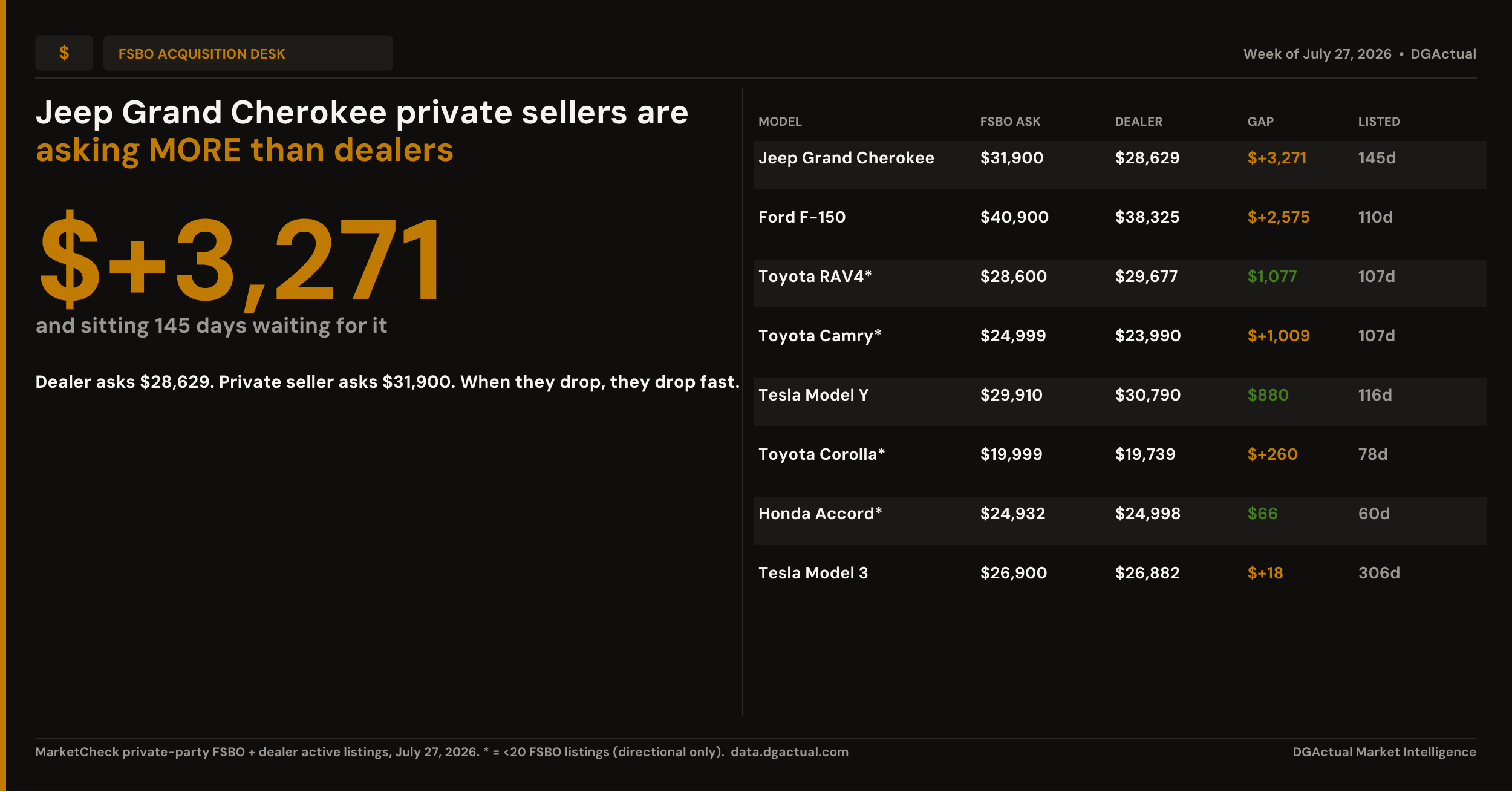
This week's FSBO data shows F-150 private sellers asking $2,575 above dealer asking price and sitting 110 days. Nissan Rogue private sellers are $3,500 below dealer median, a real acquisition window for a clean unit. Full model table with dealer-vs-FSBO price gaps and days listed in the DARPI weekly report.
Read the full DARPI weekly report at blog.dgactual.com →
Interactive segment data, model-level breakdowns, and the retail-wholesale spread tracker update every Sunday at data.dgactual.com. Source: DARPI / DGActual Retail Price Index, Week 11, July 26 2026. MarketCheck. 40M+ active dealer listings.